
Crazy Time Live Casino Game Show: UK Guide
 Available in GB
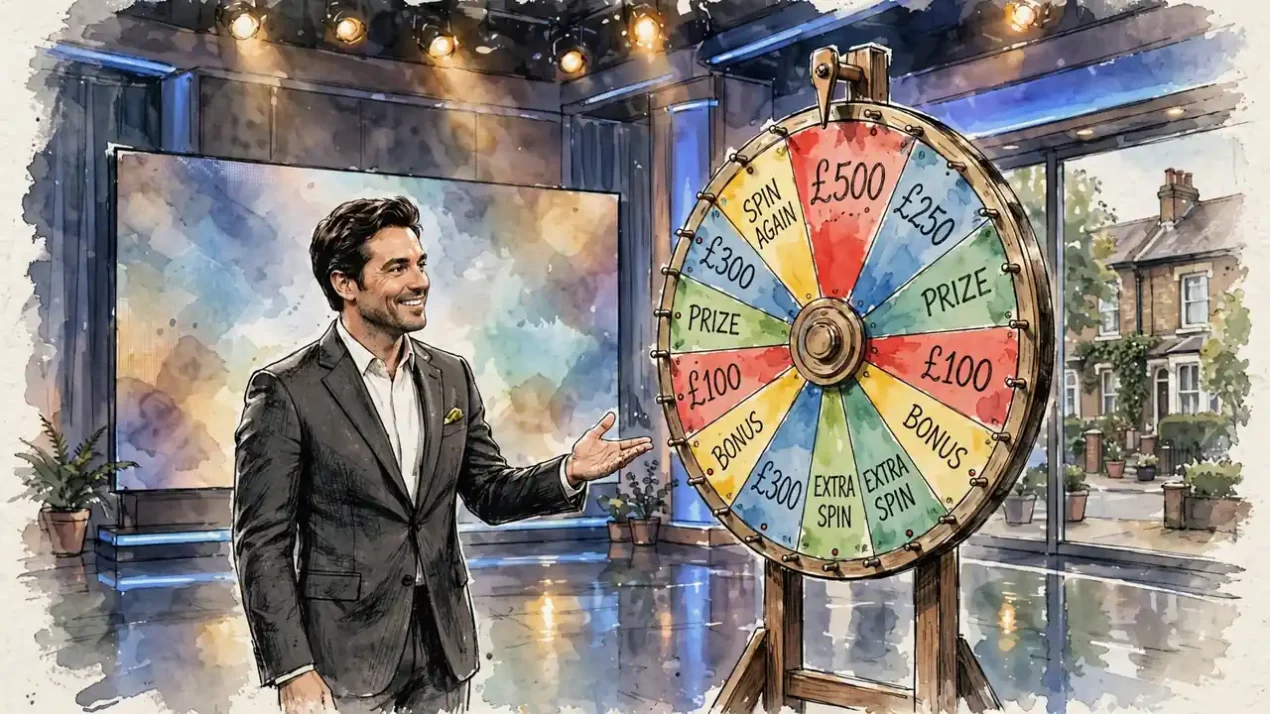
A look at Crazy Time’s presentation, game-show format and place among live casino games, with attention to what the format can and cannot tell you.
What Crazy Time Adds to the Live Casino Floor
Crazy Time belongs to the newer, more theatrical side of live casino. It is presented as a televised game show rather than a quiet table: a studio, a host, bright graphics and a wheel provide the setting, while online participants watch the broadcast and place wagers through the casino interface. The attraction is partly gambling and partly spectacle. The room has been moved onto the screen, but the language of television remains.
That distinction matters in the United Kingdom, where “live casino” describes a broad family of experiences rather than one fixed style. A conventional roulette table may be filmed from above, with the wheel and layout given nearly all the attention. Blackjack tends to make the dealer the central figure, its atmosphere borrowed from the familiar casino table. A game-show title such as Crazy Time gives the presenter and the production itself a much larger role.
Live Dream Catcher Casino UK: Game and Site Guide
The result is a different social texture. A live dealer can create the impression of a shared room, even when participants are scattered across the country and connected only through a stream. A game-show format goes further: it turns waiting into part of the entertainment. Music, animation and the rhythm of the host’s presentation fill the pauses that a traditional table might leave to conversation or silence. The casino becomes a small piece of broadcast culture.
Crazy Time is associated with Evolution, a live-game provider whose catalogue has helped make studio-based casino entertainment familiar to British audiences. Its presence also reflects a long shift in how gambling businesses present themselves. Grosvenor, for instance, introduced live casino games in 2013, with card and casino formats including Blackjack, Texas Hold’em and Roulette. The historical point is modest but telling: live casino did not arrive fully formed as a game show. It grew from established table games and gradually adopted the grammar of television.
For a UK audience, the phrase “Crazy Time casino” can therefore mean more than a particular title. It may refer to a live broadcast, a casino lobby category, or the general expectation that an online gambling session should look and sound like an event. The product sits at the meeting point of casino tradition and studio entertainment. It is neither simply a roulette table with a camera nor a television programme with the gambling removed.
UK Casino Games: Slots, Live Tables and More
The regulatory setting gives this spectacle a firm boundary. The UK Gambling Commission is the sole regulator of commercial gambling in Great Britain and oversees gambling activity, including online casinos. Its remit covers remote gambling offered to people in Great Britain even when the operator’s key equipment is located elsewhere. The Commission issues operating licences to businesses and personal licences to individuals working in the sector. Behind the coloured lights, then, lies an administrative structure that is less glamorous and rather more important.
That contrast is characteristic of online gambling: theatrical surface, formal machinery underneath. Crazy Time supplies the first; regulation supplies the second. Together they explain why the title has a recognisable place on the UK live-casino floor without being mistaken for the whole floor itself.
Recommended online casinos
- SpinFormulaBonus: 550% Up To £15,000 + 550 FS · Payout speed: 1-3 business days
- NightWinBonus: £900 + 400 free spins · Payout speed: 1-3 business days
- EvoSpinBonus: 125% up to €2500 + 125 Free Spins · Payout speed: 1-3 business days
- WinBeastBonus: €5000 + 500 FS + €650 Freebet · Payout speed: 1-3 business days
- DieselwinBonus: Welcome Pack 250% up to £4000 + 200 FS · Payout speed: 1-3 business days
- ZombillionBonus: Welcome Pack 250% up to £4000 + 200 FS · Payout speed: 1-3 business days
- ChanzeBonus: Slots Welcome Bonus #1 200% up to €500 · Payout speed: 1-3 business days
- BritsinoBonus: Welcome Package – Get your £2,200 + 2,000 FS · Payout speed: 1-3 business days
- NightLuckBonus: Welcome Pack + 805% Up To 6400€ + 280 FS · Payout speed: 1-3 business days
- AmunbetBonus: Join now and get 450% up to 2,700 GBP + 450 FS · Payout speed: 1-3 business days
Finding Crazy Time in an Online Casino
Crazy Time is normally found inside the live-casino area rather than among the ordinary slot titles. An online casino may arrange its lobby by game type, provider, or table format, so the route is often through a section labelled Live Casino, Game Shows, or something similar. The exact wording varies, but the distinction matters: a live table is presented as part of a streamed casino environment, not as a conventional reel game.
The quickest route is usually the casino’s own search field. Entering “Crazy Time” should bring up the relevant lobby tile where the game is offered. If the result does not appear, that does not prove the casino lacks the game. It may be listed under a game-show category, temporarily unavailable at that table, or hidden behind a region-specific lobby. Casino menus are rarely works of taxonomy.
A listing for an online casino with Crazy Time should make the provider or live-studio information visible somewhere on the game page. The title alone is not enough to establish what is being offered. Before opening a table, it is sensible to check whether the page identifies the game clearly, shows the live lobby controls, and explains any restrictions attached to access. A polished thumbnail is not regulatory evidence.
Verification Steps
- Identify the legal operator behind the casino brand
- Locate the licence details on the casino website
- Compare details with the UK Gambling Commission’s public register
- Confirm the licence covers remote gambling for Great Britain
- Check that the site’s terms identify the same operator and jurisdiction
Checking the operator before registration
The route to the game begins before the game screen. A casino serving consumers in Great Britain must hold the relevant remote operating licence from the UK Gambling Commission. This requirement applies whether the operator’s equipment or business base is located in Britain or elsewhere. Location is not a substitute for permission.
The Commission is the sole regulator for commercial gambling in Great Britain, and its public register is the practical place to verify an operator’s status. The casino’s footer may display a licence number, corporate name, or a link to regulatory information. Those details should be compared with the register rather than accepted at face value. The registered business name may differ from the brand shown across the website, which is why checking only the logo can leave an important gap.
A basic review before registration can therefore follow this order:
- Identify the legal operator behind the casino brand.
- Locate the licence details on the casino website.
- Compare those details with the UK Gambling Commission’s public register.
- Confirm that the licence covers remote gambling offered to Great Britain consumers.
- Check that the site’s terms identify the same operator and jurisdiction.
That is administrative work, but gambling has always depended on administration more than its advertising suggests.
What the account stage should show
Once the operator’s standing has been checked, the registration process provides another indication of how the casino is run. Operators must verify a customer’s age before allowing a deposit into a gambling account. A site that treats age checks as an inconvenience to be bypassed is not offering a harmless shortcut; it is disregarding a basic condition of legal online gambling.
Remote operators must also prompt new customers to set a financial limit before the first deposit and provide accessible account-level controls for changing limits. These controls belong to the account, not merely to the Crazy Time table. They should be visible in the responsible-gambling or account area rather than buried so deeply that they become decorative.
The payment page deserves attention as well. UK-licensed casinos cannot accept credit cards for gambling, including arrangements that route credit-card funds through a money-service business. A wallet that permits credit-card money to be used for gambling is also not an acceptable workaround. The list of available payment methods should therefore be read alongside the operator’s terms, not treated as a promise that every displayed method will be available to every account.
Before opening the live table
The game page should sit within a broader account structure that includes responsible-gambling tools, self-exclusion information, and a complaints route. UK Gambling Commission licensees must provide an internal complaints process and access to an approved Alternative Dispute Resolution service. Those details may feel distant from a brightly lit wheel, but they reveal whether the casino has built a complete service or merely assembled a persuasive front end.
A Crazy Time casino online page can be attractive, quick to load, and easy to find while still requiring careful checking. The important question is not whether the title appears in the lobby. It is whether the operator behind that lobby is identifiable, licensed for Great Britain, and equipped with the safeguards expected of a lawful remote gambling service.
Financial Risk
Any eventual gambling should remain limited to money that can be afforded to be lost.
Any eventual gambling should remain limited to money that can be afforded to be lost. The wheel supplies spectacle; the account supplies consequences.
Choosing a Casino Around the Game, Not the Promise
A casino advertising Crazy Time is making a product claim, not proving that its service is suitable for British customers. The sensible order is therefore slightly unromantic: establish who is legally responsible for the gambling service, then examine how the account works, how money can move, and what happens when something goes wrong. The wheel can wait.
Start with the licence
Remote operators serving consumers in Great Britain must hold the relevant operating licence from the UK Gambling Commission, regardless of where their technical equipment or company offices are located. The Commission is the sole regulator for commercial gambling in Great Britain, and its public register is the place to verify an operator before an account is funded.
The check should match the operator’s legal identity, trading name, domain and licence details. A logo, a footer statement or a copied licence badge is not the same thing as a register entry. The licence number should be checked on the Commission’s public register before depositing, not after a dispute has arisen.
Crash Casino Games in the UK: How They Work · Best Progressive Jackpot Slots: How the Pools Work
A dated specialist review reported that the public register dated 26 September 2026 did not identify LuckyPays under its brand or stated domain, including luckypays.io. That is a reason to treat a claim about that operator with particular care, rather than assuming that a promotional page establishes regulatory status. Register information can change, so the date and the exact entity matter.
Examine the account before the game
A credible casino should make its account conditions intelligible before money is committed. Age verification is central: operators must verify a customer’s age before allowing a deposit into a gambling account, and legal online gambling in the UK is for adults aged 18 and over where the operator holds the required Commission licence.
The same early inspection should cover:
- identity checks and when they may be requested;
- account-level deposit, loss or wagering controls;
- how those limits are set, changed and displayed;
- withdrawal verification and the documents that may be required;
- account closure and self-exclusion procedures;
- the operator’s complaints route.
Remote operators must prompt new customers to set a financial limit before the first deposit and provide accessible controls at account level. This is more meaningful than a general “play responsibly” slogan: the controls should be visible, usable and connected to the account rather than buried in help pages.
Treat payments as part of regulation
Payment methods reveal whether a casino understands the market it serves. UK-licensed casinos cannot accept credit cards for gambling. The restriction also covers credit-card funding routed through a money service business, and a wallet cannot be used where it allows credit-card funds to be used for gambling.
That makes the payment page worth reading before any deposit. It should be clear which methods are permitted, whether a payment account must belong to the casino customer, and how withdrawals are handled. A casino that presents a payment route in vague terms creates avoidable uncertainty, particularly when a transaction is later reviewed for verification.
Do
- Verify operator status on the UK Gambling Commission register
- Set a financial limit before the first deposit
- Use accessible account-level controls
Don’t
- Accept a logo or footer statement as proof of a licence
- Use credit cards for gambling
- Bypass age verification processes
No deposit method should be treated as a guarantee of a smooth withdrawal. The relevant question is whether the operator explains its process and applies it consistently.
Look for safeguards, not decoration
Responsible-gambling tools should be practical rather than ornamental. UK Gambling Commission-licensed casinos must provide tools that include self-exclusion, alongside account controls that help restrict gambling activity. GAMSTOP is the national self-exclusion service for participating online operators, while an individual casino should also explain its own internal process.
The presence of a tool is only the beginning. Its location, activation process and effect on the account matter. A limit that is difficult to find is less useful than one presented clearly at the point when the account is opened. The same applies to self-exclusion: the terms should explain what happens to the account and how existing balances are treated.
Gambling should remain limited to money that can be afforded to lose. That is not a decorative disclaimer; it is the boundary that makes any entertainment claim honest. If gambling is becoming difficult to control, GamCare, BeGambleAware and Gamblers Anonymous offer support.
Check what happens after a complaint
A licensed operator must offer an internal complaints process and access to an approved Alternative Dispute Resolution service. The complaints policy should identify the first route, explain how the matter is recorded, and state what happens if the casino’s response does not resolve it.
This is a useful test of seriousness. A polished game page says little about an operator’s conduct; a clear complaints policy says more. The policy should be readable without requiring an argument with customer support first.
Best Live Casino UK: How Live Tables Work
The strongest assessment of Crazy Time casinos in the UK is therefore not based on a banner promising excitement or a claim that a game is “official”. It rests on verifiable licensing, visible financial controls, lawful payment arrangements, usable safeguards and a defined route for complaints. The game may attract attention. The surrounding system deserves the scrutiny.
Where Crazy Time Sits Among Live Casino Games
Crazy Time belongs in the live-casino area rather than among ordinary digital slots. Its visual language is that of a television game show: a studio, a presenter, a large wheel and a table of wagers shown as the action unfolds. That makes the game easy to recognise in a casino lobby, even when the surrounding catalogue contains dozens of unrelated titles.
The most natural place to look is a section labelled Live Casino, Live Games or Game Shows. Some lobbies arrange titles by provider, while others separate wheel games from card tables. The exact menu depends on the operator’s design, but the useful distinction is between games streamed from a live studio and games generated entirely by software. Crazy Time is part of the former group.
A wheel game beside the tables
The wheel is the game’s defining object, but it does not place Crazy Time in the same category as roulette. Both use a circular layout and a visible result, yet they belong to different traditions. Roulette is a table game built around the spin of a numbered wheel and the familiar division between colours, numbers and combinations. Crazy Time uses a game-show wheel with its own sections and accompanying features. Similar furniture; different room.
Roulette
A table game built around a numbered wheel and familiar betting layouts.
Blackjack
A card game organized around individual hands and a dealer.
Crazy Time
A theatrical game-show format featuring a studio, a host, and a specialized wheel.
That distinction matters when moving through a live-casino catalogue. A player looking for roulette may find Crazy Time nearby because both are wheel-led games. A player searching for a more theatrical format may find it under game shows instead. The label is less important than the live presentation and the title displayed on the table.
Blackjack occupies another established corner of the same floor. It is a card game, usually presented through a dealer and a clearly marked table, with the action organised around individual hands. Crazy Time has no equivalent card-table rhythm. Its appeal lies in the shared spectacle of the wheel and studio rather than in a private contest with a dealer. Live casinos can therefore place both titles side by side without suggesting that they offer the same experience.
Reading the catalogue, not the advertising
A live lobby is best understood as a map of formats. Card games may include blackjack and Texas Hold’em; roulette provides the classic wheel-and-table tradition; game-show titles add a more openly broadcast style. Grosvenor’s live casino history illustrates how this range developed: when the operator introduced its live casino games in 2013, the selection included Blackjack, Texas Hold’em and Roulette. The catalogue has room for both old casino furniture and newer studio productions.
Deal or No Deal Casino UK: Slot Formats Explained · Chicken Road Casino UK: Game Type and Evidence
This is where Crazy Time sits: between the formal language of casino tables and the exuberance of a television set. Its title may appear in a dedicated game-show row, in a wheel-games filter or among a provider’s live releases. The surrounding menu can reveal more than a banner can. A table marked as live, a visible presenter and a studio stream indicate the format; a generic slot grid indicates something else.
For anyone trying to locate the Crazy Time casino game, the practical task is therefore classification rather than detective work. Open the live section, inspect the game-show or wheel categories, and distinguish the title from roulette, blackjack and conventional slots. The same catalogue may contain all of them, but proximity is not equivalence. That is the small geography of the live floor.
The Game-Show Format and the Limits of Strategy
Crazy Time looks less like a conventional casino table than a piece of television that has wandered into a gambling room. A presenter, a brightly coloured wheel and a studio audience create a sense of occasion. That atmosphere matters: game shows are built around anticipation, recognition and small rituals, while the underlying outcome remains determined by the game’s rules rather than by the mood in the studio.
This is where the phrase “Crazy Time casino strategy” needs careful handling. Strategy can mean understanding what is being wagered on, reading the available options correctly and setting a personal limit before play begins. It cannot turn a random result into a planned one. A player may make a deliberate choice about where to place a wager, but cannot make the wheel land in a preferred segment.
Strategy Limits
A player may make a deliberate choice about where to place a wager, but cannot make the wheel land in a preferred segment.
What strategy can actually do
A sensible Crazy Time live casino strategy begins with interpretation, not prediction. The interface should be understood before money is involved: which areas accept wagers, when wagering closes, how the selected area is displayed and what happens after the result appears. Confusion at the table is not a system; it is merely expensive confusion.
It is also possible to treat a session as a series of separate decisions rather than as a story. A previous result does not create an obligation for a different result next time. A run of similar outcomes may look meaningful, especially when a presenter gives each spin a theatrical build-up, but the appearance of a pattern is not proof of control. Casino history is full of devices that make chance feel narratively organised. The wheel is simply a particularly colourful one.
The useful limits of a game strategy are therefore modest:
- understand the wager options before selecting one;
- decide in advance what amount can be lost without affecting ordinary finances;
- avoid increasing a wager merely because an earlier result was disappointing;
- stop when the personal limit has been reached;
- keep records only as records, not as instructions from the future.
The final point matters because “Crazy Time tracker” tools and casino trackers can sound more authoritative than they are. A record of previous outcomes may help describe what has happened in a session. It cannot establish what the next spin must produce. Past results are not a control panel.
Tracking, memory and the illusion of a system
A tracker can encourage the eye to search for sequences: repeated colours, missing segments or a result that seems overdue. That habit is understandable. Human beings are skilled at finding shapes in noise; it is one reason constellations were imagined in the sky and streaks are detected in roulette results. In a casino, however, pattern recognition can quietly become a reason to wager more.
No Crazy Time casino tracker can make an uncertain outcome predictable merely by presenting earlier results in a table or graph. Nor does a “strategy” become reliable because it has a name, a spreadsheet or a confident explanation. The format may change the pace and emotional texture of play, but it does not grant the player influence over the wheel.
The most defensible Crazy Time casino game strategy is thus a boundary around behaviour, not a formula for winning. It preserves the distinction between making a choice and controlling a result. Those are not the same thing.
Understanding Strategy
- A strategy is a boundary around behaviour, not a formula for winning
- Previous results do not influence or predict the next spin
- Use trackers only as a historical record, not as a control tool
Why ‘Slot’ Does Not Mean the Same Rules Everywhere
The word “casino” is broad enough to make unlike things appear related. Crazy Time belongs to the live-casino world: a presenter conducts the game, the action is broadcast from a studio, and the result comes from the game’s own wheel and rules. An online slot is a different construction. It is a digital machine game in which each game cycle is generated electronically, without a live presenter determining the sequence.
That distinction matters because British gambling controls do not treat every casino product as an online slot. A live game may sit in the same lobby as slot titles, yet its presence there does not turn it into one. The label is not decorative; it determines which regulatory rule is relevant.
The stake rule for online slots
For Great Britain, a specialist review describes the online-slot stake limits as follows:
- adults aged 25 and over may stake no more than £5 per game cycle;
- adults aged 18 to 24 may stake no more than £2 per game cycle.
These are limits on the individual amount staked in an online slot cycle, not a general ceiling for every game found on an online casino site. They should therefore not be transferred automatically to Crazy Time simply because the game appears beside slot titles or because its presentation has the bright, theatrical language of a television game show.
The same distinction also matters when people look for Crazy Time results, recent outcomes or a record of previous rounds. A result belongs to the particular live game and its published mechanics; it is not a slot spin merely because money was placed online. Past results do not alter the classification, and they do not turn a sequence of outcomes into a reliable method for controlling the next one.
Roulette and blackjack are separate cases
A specialist review also describes the Great Britain slot limits as not applying to roulette or blackjack. These games have their own structures, even when delivered through a live studio and accompanied by a presenter. Roulette is organised around a wheel and its betting layout; blackjack around cards, player decisions and the dealer’s hand. Neither becomes an online slot through digital delivery.
Crazy Time belongs in that same conversation about classification, but not because it shares roulette’s or blackjack’s rules. Its live presentation and game format make it distinct from an online slot, while its own rules determine how a round works. Calling it a “slot” in casual conversation may be convenient, but convenience is a poor substitute for regulatory precision.
Online Casino Games for Real Cash in the UK
This is also why promotional language can mislead. A page advertising casino bonuses may place live games and slots under one general heading, while the legal treatment of the products remains different. A bonus description does not rewrite the nature of the game, and an attractive interface does not change the stake category attached to it.
The sober reading is the useful one: identify the product first, then apply the rule that belongs to that product. A live casino game is not an online slot by atmosphere, location or marketing copy. Different machinery, different treatment.
Trying Crazy Time Without a Deposit
A free version of Crazy Time can be useful for one modest purpose: discovering whether the format feels intelligible before money enters the picture. A no-deposit trial is not a cash account, not a bonus balance and not permission to wager. It is a way of observing the table, the wheel and the changing panels without turning curiosity into a financial decision.
That distinction matters because “free spins” is slippery language. In a conventional online slot, it may describe promotional rounds. In a live casino search, it can also lead towards pages discussing a demo, a bonus or a real-money game. The phrase alone does not establish that Crazy Time is available without a deposit, or that any particular casino provides free access in the United Kingdom.
What a free trial can show
A demo or play-for-fun presentation may help establish whether the live format is comfortable to follow. It can reveal:
- how the game screen is arranged;
- where the wheel and betting controls appear;
- how outcomes are displayed;
- whether the pace of the presentation suits the player;
- how clearly the studio, host and game information are shown.
These are interface impressions, not evidence of future results. A free session cannot turn chance into a pattern, and it does not demonstrate that real-money play will feel identical. Some trial versions may simplify the presentation, omit account features or use a different route into the game.
Searches for a Crazy Time casino review, including UK-focused reviews, therefore need careful reading. A review describing a “free” option may mean a demonstration page rather than free spins attached to a funded account. It may also be discussing an operator’s promotional wording. The useful question is not whether the word free appears, but what the access actually permits and whether any deposit is required.
Keeping the boundary clear
A no-deposit trial should remain separate from registration and payment decisions. If a page moves quickly from a demo button to account creation, its terms deserve attention before any funds are added. Age verification applies before an operator allows deposits, and real-money gambling in Great Britain belongs with operators holding the appropriate UK Gambling Commission licence.
Age Verification
Attention Operators must verify a customer’s age before allowing a deposit into a gambling account.
Even a free session should not be treated as risk-free in the wider sense. It can make a game more familiar, but familiarity can also make later wagering feel deceptively routine. The sensible boundary remains plain: only gamble what can be afforded to lose.
Bonuses, Deposits and the Small Print
A Crazy Time casino bonus can sound as though it belongs to the game itself. Usually, it belongs to the casino account instead. The distinction matters: a welcome promotion may be attached to a new account, a deposit bonus may require an eligible payment, and a no-deposit offer may come with its own activation and withdrawal conditions. None of those phrases, on their own, establishes that an offer is available.
The first question is whether the promotion can actually be used for live casino play. Some terms divide a balance into cash and bonus funds, while others exclude particular games, tables or game categories. A page mentioning Crazy Time is not enough. The full promotional rules determine whether wagers on the game count towards any requirement, whether bonus funds may be used there, and whether winnings connected with the promotion can be withdrawn.
Casino Dice Games in the UK: Online and Table Play
“Wagering requirements” are not decorative small print. They describe how the bonus and any associated winnings must be wagered before withdrawal becomes possible. The wording should be read alongside the qualifying deposit, eligible games, contribution rules, expiry provisions and any maximum withdrawal condition. If the explanation is vague, the offer is vague.
Payment eligibility is a separate matter. A casino may accept a deposit method for ordinary play while excluding it from a promotion. Credit cards cannot be used for gambling with UK-licensed casinos, and a wallet funded by a credit card cannot be used for that purpose either. A promotion therefore cannot make an ineligible payment route acceptable.
The same caution applies to claims about Crazy Time casino payouts. A payout description should not be confused with a promise that a bonus-funded balance can be withdrawn immediately. Account verification, the original payment method and the promotion’s own conditions may all affect the process.
Can I use credit cards for gambling?
UK-licensed casinos cannot accept credit cards for gambling, including arrangements that route credit-card funds through a money-service business.
What are wagering requirements?
They describe how a bonus and any associated winnings must be wagered before withdrawal becomes possible.
Is Crazy Time an online slot?
No, it is a live casino game streamed from a studio, which is a different construction from a digital machine-generated slot.
A phrase such as “Crazy Time casino not on GamStop” also changes the subject rather than improving the offer. GAMSTOP is a self-exclusion service; looking for an alternative should not be treated as a bonus feature. Licensed casinos must provide responsible-gambling tools, including self-exclusion, and the sensible boundary remains plain: gamble only what can be afforded to lose. Small print is still the largest part of the deal.
Rules, Scores and Multipliers at a Glance
Crazy Time is a live, wheel-based casino game presented as a studio game show. Its basic rule is uncomplicated: the wheel is spun, and the result determines the round. Most segments carry a number, while others lead to bonus rounds. The apparent simplicity is part of the format’s theatre; it is not evidence that the outcome can be directed.
The number segments represent the principal scoring categories. A result matching a selected number settles the round according to that category’s published rules. The word “score” is therefore used rather loosely in casino descriptions: it may refer to the winning segment, the return attached to a result, or a summary shown in the game interface. It is not a personal performance rating.
Mines Casino Game UK: How It Works and What to Know
What multipliers mean
A multiplier is a figure applied to an eligible result under the game’s stated settlement rules. It can increase the return attached to a winning outcome, but it does not turn a losing selection into a winning one. The multiplier displayed for a round belongs to that round’s result; it is not a forecast of the next spin.
Bonus segments are separate from the numbered outcomes and use their own instructions. Their screens may show additional choices, prizes or multiplier values. Those details should be read from the live rules panel or the operator’s current game information, since presentation and terminology can change between versions.
For a clear overview, the essential vocabulary is:
- Wheel result: the segment selected by the spin.
- Number segment: a standard outcome category.
- Bonus segment: an outcome that opens a distinct game feature.
- Multiplier: a value applied where the rules make it eligible.
- Settlement: the way the round’s winning result is calculated and paid.
No table of previous results changes the rules of the next spin. A record of scores is a history, not a control panel. Keep the distinction intact, and gamble only what can be afforded to lose.
A Demo as a Way to Learn the Interface
A Crazy Time casino demo is best understood as a rehearsal for the screen, not as a miniature casino with the same practical consequences as real-money play. Where a Crazy Time live casino demo is available, it can show how the wheel, host feed, wager controls and result display are arranged. That matters because a game-show interface has more movement than a conventional digital table. Bright graphics are entertaining; they are also perfectly capable of hiding a button in plain sight.
A trial view may help clarify:
- where the available wager areas appear;
- how selections are displayed before a round;
- where the game result and any multiplier information are shown;
- how the live video, chat and table controls share the screen;
- which panels open or collapse on a smaller device.
This is interface knowledge, not a method for controlling outcomes. A demo cannot turn random results into a skill contest, and familiarity with the layout does not alter the game’s underlying rules. It simply removes some of the novelty before money enters the picture.
Searches for a Crazy Time demo casino or a Crazy Time slot demo can also create a category problem. Crazy Time is a live casino game, so a page labelled “slot demo” may be using loose promotional language rather than describing an actual online slot. The presence of a demo should therefore be confirmed on the specific casino page; it should never be assumed from the game’s name or from a generic casino lobby. If real-money play follows, only funds that can be afforded to lose should be used.
Are online casino games licensed and regulated?
Yes. The UK Gambling Commission regulates commercial gambling in Great Britain, including online casinos, and remote operators serving consumers there must hold the relevant licence.
What are the online slot stake limits in Great Britain?
The limit is £5 per game cycle for adults aged 25 and over and £2 for adults aged 18 to 24. These limits do not apply to roulette or blackjack.
Is LuckyPays licensed by the UK Gambling Commission?
The Gambling Commission’s register dated 26 September 2026 does not list LuckyPays under its brand or stated domain, including luckypays.io.
Related posts

Terms of Use

Top Rated Online Casinos UK: What Ratings Mean