
Best Online Casino Game Shows in the UK: How They Work
 Available in GB
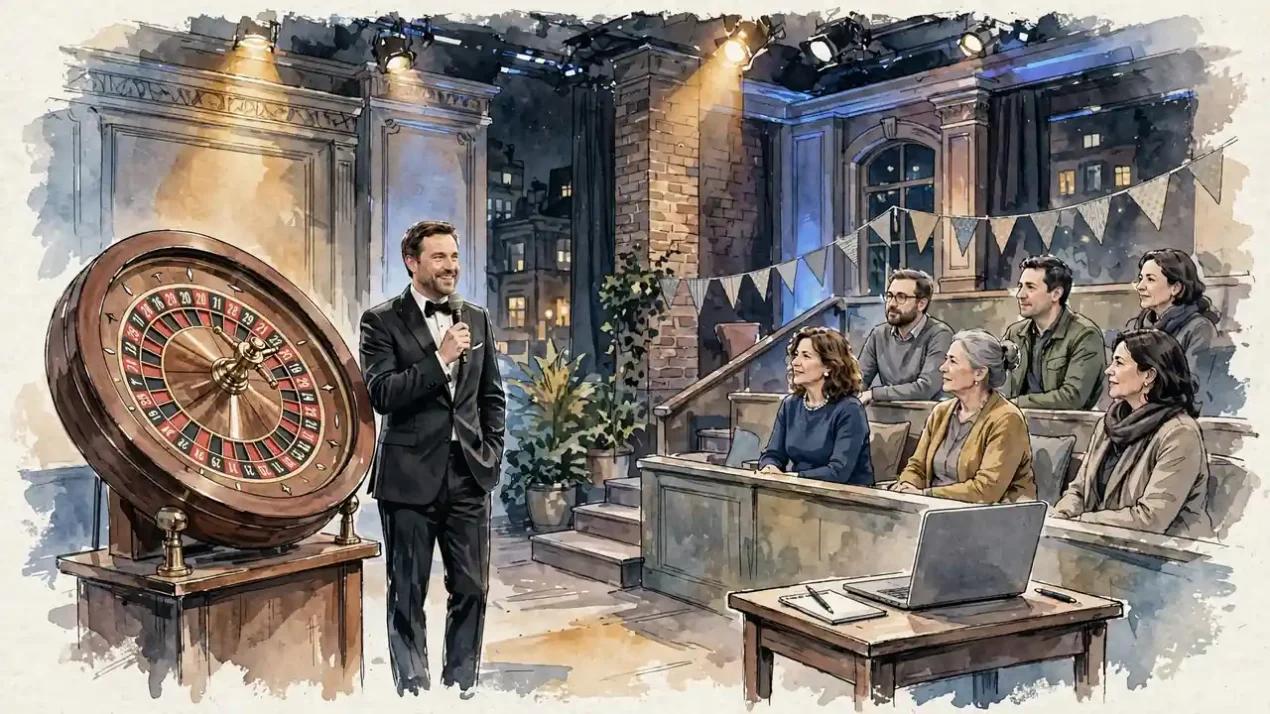
Live casino game shows pair studio presentation with remote betting, creating a broadcast-style format that still functions as online gambling.
How Live Casino Game Shows Work in the UK
Live casino game shows borrow the visual language of television and place it inside a remote gambling environment. A presenter appears in a studio, explains what is happening, and conducts the round while software records the result and settles the bets. The result is neither a conventional casino table nor a television programme watched passively. It is a gambling product arranged as a broadcast.
That distinction matters. A standard online casino game is generally driven by software alone: the screen displays the rules, the player chooses a stake, and a random-number system determines the outcome. A live game-show format adds a human host, a studio set, cameras, microphones and a scheduled sequence of rounds. The presentation may resemble a quiz, a prize-wheel programme or a brightly lit variety show, but the underlying relationship remains that of remote gambling. Money is staked at a distance, and the operator records and settles the transaction through an online account.
Broadcast atmosphere, casino function
The studio is part of the product’s appeal. A presenter gives the round a rhythm that a silent game cannot easily reproduce. There may be an introduction, a period in which bets are accepted, a closing point, the reveal of the outcome and a settlement. Graphics show the available choices or the state of the round. The camera turns a private screen into something that feels social, even when the player is sitting alone.
That theatrical quality can obscure the commercial structure. The host may speak in the language of entertainment, yet the central action is still a wager. The decorations, music and conversation do not turn a casino game into a harmless show; they make the casino game easier to watch. Television taught audiences to associate presenters and studio rituals with leisure. Online casinos have made use of that association with considerable confidence.
A live show is therefore best understood through two layers:
- The presentation layer: a studio, host, cameras, graphics and a sequence that unfolds in real time.
- The gambling layer: an account, a stake, an outcome, a settlement and the operator’s obligations under the rules governing remote gambling.
The first layer explains why these games feel different from ordinary slots or digital table games. The second determines their legal status in Great Britain.
What happens during a round
The exact design varies between formats, but a live game-show round commonly follows a recognisable pattern. The host opens the round, the interface displays the available betting choices, and the operator accepts stakes during a defined period. Once betting closes, the host or studio mechanism produces the result. The platform then calculates any return and updates the account.
This sequence creates a visible boundary between participation and observation. A player may watch the host speak, the wheel turn or the result appear, but only the part of the process recognised by the game rules has financial significance. The presenter cannot negotiate an outcome with an individual participant, and the atmosphere of a shared event does not make the result personal. The show is live in its delivery; it is still governed by pre-set rules.
The word “live” can also be misunderstood. It does not necessarily mean that every element is improvised or that the result is created by the host’s judgement. It normally refers to a real-time studio feed and an unfolding round. The technology joins that feed to the account system, allowing bets to be placed and settled while the programme is in progress.
Slot Providers: Casino Games by Studio
For the player, the practical experience is closer to joining a broadcast than opening a digital slot. The interface may show a chat panel, a list of recent results or other viewers’ activity, but such features do not alter the operator’s responsibility. They are part of the presentation around the wager, not a substitute for licensing, age checks or financial safeguards.
The British regulatory boundary
In Great Britain, the presence of cameras does not create a separate legal category beyond the reach of gambling regulation. The UK Gambling Commission oversees gambling activity, including remote casino services. Its remit covers remote gambling supplied to consumers in Great Britain even when important equipment is located elsewhere. A studio abroad does not, by itself, place the service outside the British regulatory framework.
The Gambling Commission is the principal commercial gambling regulator for Great Britain. It grants operating licences to businesses and personal licences to individuals whose roles require them. That division reflects the two sides of the industry: the company must be authorised to provide the gambling service, while relevant people involved in operating it may also need personal authorisation.
The UK Gambling Commission oversees gambling activity, including remote casino services, even if important equipment is located abroad.
The rules are rooted in the Gambling Act 2005 for England, Wales and Scotland. Northern Ireland has a separate legal position, so “the UK” is not always a perfectly precise shorthand when regulatory detail is being discussed. For remote casino play aimed at consumers in Great Britain, however, the important question is whether the operator holds the appropriate UKGC licence. The location of a presenter, production studio or technical system does not replace that requirement.
This is why a live game show should not be judged by its appearance. A polished set and a recognisable broadcast style say nothing about the operator’s legal authority. Nor does a familiar brand name settle the matter. The relevant authorisation belongs to the gambling business providing the service to British customers.
Protection follows the operator
The operator, rather than the host or studio supplier, carries the central consumer responsibilities. It is the operator that holds the customer account, handles deposits, records stakes, settles winnings and provides the complaints route. The studio can supply the visible event, but it does not become the player’s gambling counterparty merely because its presenters appear on screen.
That arrangement reflects a broader feature of remote gambling. Much of the experience is distributed across different systems: a studio produces the broadcast, software connects it to the betting interface, and the licensed operator administers the account. For the customer, those parts may appear as one seamless product. Legally and practically, they still perform different functions.
A properly authorised operator must also deal with age and identity controls before allowing remote gambling activity in accordance with the applicable requirements. The purpose is not theatrical. It is to establish who holds the account and prevent access by people who are not permitted to gamble. A bright studio and an informal presenter can make the experience feel light; the account behind it is subject to formal checks.
Best Online Casinos with No Limits: UK Rules Explained
The same principle applies to money. A live game-show interface may make the wager look like a moment in a programme, but the operator must treat it as a financial transaction within the regulated system. The account history, deposits, stakes and settlements remain part of the remote gambling record.
Financial limits before the first deposit
UKGC-licensed operators must ask customers to set a financial limit before the first deposit is made. This requirement places a pause before money enters the gambling account, rather than leaving all budgeting to the excitement of the session itself. If a customer lowers an existing limit, the reduction must take effect immediately.
The rule is particularly relevant to live shows because their format encourages continuity. One round follows another; the presenter keeps the pace moving; the screen supplies a sense of an event that would be inconvenient to leave. A financial limit interrupts that momentum with a decision made before the account is funded. It is a small piece of administration placed deliberately in front of entertainment.
Barcrest Online Casinos UK: Games and How They Work
A limit is not a prediction of a player’s behaviour and does not make losses impossible. It is a boundary set within the account system. The significance lies in the timing: the operator must prompt for it before the first deposit, when the decision is not being made in the middle of a sequence of rounds.
The immediate effect of reductions matters for the same reason. A lower limit that waits for a later processing window would not offer the same protection as one that changes at once. Here, the rule is unglamorous but clear. Good intentions are not a control mechanism.
GamStop and self-exclusion
GamStop has been compulsory for every online operator licensed in Great Britain since 31 March 2020. It is the national self-exclusion scheme connecting participating operators, so a person who has chosen to exclude through GamStop is not simply relying on a single casino’s internal setting.
GamStop
GamStop is the national self-exclusion scheme connecting participating operators. A person who has chosen to exclude through GamStop is not simply relying on a single casino’s internal setting, but a system that applies across GB-licensed operators.
For live game shows, this matters because the broadcast format can be encountered across more than one operator. A player may see a similar style of entertainment in different lobbies, with different branding around the studio content. A self-exclusion system that applies across GB-licensed operators addresses that wider pattern rather than treating each account as an isolated island.
GamStop does not turn the live show into a regulated television channel, nor does it assess whether a particular programme is entertaining or persuasive. Its role is narrower and more practical: it supports a person’s decision to exclude from online gambling with participating GB-licensed operators. The licensed operator must operate within that framework.
What “best” can and cannot mean
The phrase “best online casino game shows UK 2026” sounds as though a stable league table ought to exist. Live casino entertainment is less obedient than that. A show can be preferred for its presenter, pace, visual style or interface, while another may appeal because its rounds are easier to follow. Those are judgments about presentation and personal taste, not regulatory facts.
Amatic Casino UK: How the Games and Operators Work
The British setting supplies firmer criteria. A live game-show service aimed at Great Britain belongs inside the UKGC licensing framework. The operator should be identifiable as the licensed business providing remote gambling, and the account should operate with the protections associated with that framework, including the financial-limit prompt and GamStop availability. Those are structural features, not decorative badges.
The word “best” also should not be confused with “most exciting”. A loud studio, quick graphics and a persuasive host can make a product memorable, but they do not establish fairness, suitability or legal status. Entertainment has always been skilled at borrowing the authority of ceremony. Regulation asks a less glamorous question: who is responsible for the wager?
The difference from ordinary online casino games
Live game shows sit between several familiar forms of casino entertainment. They are more staged than a conventional digital table game, more interactive in appearance than a slot, and more immediate than a recorded video. Yet they remain remote casino products because the player participates through an online account rather than standing in a physical venue.
Their distinctive feature is not simply that a camera is present. It is the combination of:
- a live or near-live studio presentation;
- a host-led sequence of rounds;
- an online interface for placing a stake;
- a result produced under the game’s rules; and
- account-based settlement by the operator.
Remove the betting interface and the result is a television-style show. Remove the host and studio, and it becomes a more conventional digital casino game. Bring both together and the product occupies the particular space commonly called a live casino game show.
That hybrid character explains its cultural appeal. It takes the solitary act of remote gambling and wraps it in the social grammar of a shared broadcast. The player sees a room, a host and a rhythm of expectation rather than only symbols and buttons. The technology has not abolished the casino; it has given the casino a studio audience of one.
Reading the format without losing sight of the rules
The most useful way to understand online casino game shows is to separate atmosphere from authority. The atmosphere comes from the presenter, set, sound and pace. Authority comes from the licensed operator and the rules that govern remote gambling in Great Britain.
Core Responsibility
The licensed operator is the entity responsible for the wager, account, and regulatory compliance, regardless of the studio or presenter.
The UK Gambling Commission’s role reaches the gambling service regardless of where the key equipment is situated. The business supplying the service needs the relevant operating licence, and individuals in regulated roles may need personal licences. The operator must support the protections built into the British system, including GamStop and the requirement to prompt for a financial limit before the first deposit. A reduction to that limit must be applied without delay.
This framework does not tell audiences which show they will enjoy. It does something more basic and more important: it identifies the conditions under which a live casino product can lawfully be offered to consumers in Great Britain. The studio may sparkle. The account remains accountable.
That is the essential shape of the format: part broadcast, part casino, wholly a form of remote gambling when money is placed through an online operator. The lights are incidental. The licence is not.
Recommended online casinos
- SpinFormulaBonus: 550% Up To £15,000 + 550 FS · Payout speed: 1-3 business days
- NightWinBonus: £900 + 400 free spins · Payout speed: 1-3 business days
- EvoSpinBonus: 125% up to €2500 + 125 Free Spins · Payout speed: 1-3 business days
- WinBeastBonus: €5000 + 500 FS + €650 Freebet · Payout speed: 1-3 business days
- DieselwinBonus: Welcome Pack 250% up to £4000 + 200 FS · Payout speed: 1-3 business days
- ZombillionBonus: Welcome Pack 250% up to £4000 + 200 FS · Payout speed: 1-3 business days
- ChanzeBonus: Slots Welcome Bonus #1 200% up to €500 · Payout speed: 1-3 business days
- BritsinoBonus: Welcome Package – Get your £2,200 + 2,000 FS · Payout speed: 1-3 business days
- NightLuckBonus: Welcome Pack + 805% Up To 6400€ + 280 FS · Payout speed: 1-3 business days
- AmunbetBonus: Join now and get 450% up to 2,700 GBP + 450 FS · Payout speed: 1-3 business days
Finding Live Game Shows at UK Online Casinos
The phrase “online casino with live game shows” sounds as though it describes a simple category. In practice, it describes a checking exercise. A casino may advertise live tables, streamed dealers or a broad games lobby without carrying the particular show-style content being sought. A polished homepage proves very little. The useful evidence sits deeper in the operator’s catalogue, terms and licensing information.
The first distinction is between an operator and a software provider. A provider supplies games to licensed businesses; it does not necessarily accept deposits, process withdrawals or answer player complaints. The operator is the business that opens the gambling account and carries the responsibilities attached to it. That difference matters because a provider’s UK Gambling Commission authorisation does not turn every website displaying its titles into a lawful British casino. The consumer-facing operator needs the appropriate UKGC licence.
Amatic online casinos in the UK: how they work
Start with the operator’s own catalogue
A serious check begins inside the casino rather than with a search result or an advertising banner. The games lobby should identify its categories clearly enough to separate live-show content from ordinary slots, RNG table games and streamed dealer tables. Labels such as “live”, “game shows” or “live entertainment” can be useful signposts, but a label is not a guarantee that every title shown under it is available for every account, jurisdiction or payment status.
Availability can vary with location, account verification, technical supply and the operator’s current contract with a provider. A title displayed in a general catalogue may be unavailable when the account is logged in from Great Britain, while a promotional page may continue to exist after the underlying content has changed. The dependable question is narrower: does the licensed operator currently show the relevant game in its Great Britain-facing lobby, with the rules and access conditions attached to that account?
The operator’s help centre can add useful detail. It may explain whether the content runs in a browser, whether a mobile version exists, and which technical requirements apply. Those details belong to the particular operator, not to live game shows as a universal class. A mobile-friendly layout is not evidence of lawful licensing, and a familiar interface does not replace a licence check.
A catalogue also needs to be read as a catalogue, not as a promise. “Hundreds of games” says nothing about how many are live shows. “Live casino” may refer entirely to roulette, blackjack and baccarat with human dealers. “Entertainment casino” may contain a mixture of formats whose rules differ substantially. The name of the section is a clue; the actual title and its information page are the evidence.
Check the operator, not merely the game
The UK regulatory question concerns the business offering remote gambling to people in Great Britain. The location of its servers or the identity of the game supplier does not remove that obligation. Remote operators serving the British market must hold the relevant UK Gambling Commission licence, and the Gambling Commission is the sole commercial gambling regulator in Great Britain.
Do
- Check the operator’s legal name against the Gambling Commission Public Register.
- Verify that the business on the account matches the registered licensee.
Don’t
- Rely solely on a brand logo or reference displayed in a website footer.
- Assume a software provider’s authorisation makes the website itself licensed.
The licence should be checked against the Gambling Commission Public Register. An operator’s footer may display a logo or a licence reference, but a logo is easy to copy and a reference can become outdated. The register is the place to compare the legal name, trading name, licence status and activities authorised. The name on the account and payment pages should make sense alongside the business named in the register. Where several brands belong to one group, the registered licensee may not be identical to the brand printed across the website.
This is not a decorative administrative step. The licence identifies the business responsible for deposits, withdrawals, bonus terms, account verification and customer support. A software supplier can hold a UK Gambling Software (Remote) licence while remaining outside the consumer relationship. Amatic Industries GmbH is an example of that distinction: its authorisation permits supply to British operators, not direct acceptance of player funds. A provider’s presence in a lobby therefore cannot establish that the website itself is licensed.
The same principle applies to an editorial listing. A casino review, a provider page or an aggregator can say that a brand carries particular content, but none of those statements is a register entry. Availability claims and licensing claims need separate checks.
Read the licence details with care
A current listing is only the beginning. The register also helps establish whether the business is authorised for the kind of remote gambling being offered. A site may present itself as a casino while operating through a different corporate entity, or it may display a brand whose ownership has changed. The legal entity behind the account should not be treated as a footnote.
Attention A foreign licence cannot substitute for a UKGC licence for players in Great Britain.
The Gambling Act 2005 governs gambling in England, Wales and Scotland, while Northern Ireland has a separate legal position. For a Great Britain-facing casino, the relevant test is whether the operator holds the required UKGC licence for remote gambling. This is why a foreign licence cannot substitute for a UKGC licence. Offshore casinos may be freely accessible in technical terms, but they operate outside the British regulatory system and do not provide the same UK framework for complaints, supervision and consumer protection. A British player is not committing a criminal offence merely by playing there; that does not make the site a UK-licensed casino.
The practical result is plain: a website offering live-show gambling to Great Britain customers should be treated as a British regulated service only when its operator can be matched to a current UKGC record. Advertising language cannot perform that match.
Confirm the content after the licence check
Once the operator’s status has been established, the content itself can be assessed. The relevant signs are specific rather than theatrical:
- a dedicated live-show or game-show category in the Great Britain-facing lobby;
- a title page explaining the game’s format and any applicable rules;
- an indication of whether the game is available for real-money play, demonstration play or both;
- compatible browser and mobile information;
- a support article explaining what happens when a session is interrupted;
- clear references to the operator responsible for the account.
The last point is often overlooked. A streamed game may look as though it belongs to a studio, while the player’s contract is with the casino. The studio supplies the production or game system; the licensed operator handles the account. If a withdrawal is delayed or a dispute arises, the studio’s branding does not change where the complaint must begin.
Game pages should also be read for the difference between a live broadcast and a live game. A broadcast may show presenters or a studio without offering an interactive gambling product. Conversely, a live-dealer table may involve a real person but not fit the game-show format at all. The catalogue needs to establish both elements: live presentation and the particular game structure being offered.
Treat lists as leads, not proof
Third-party lists can save time by identifying operators that may carry a certain category. They are not a substitute for a current check. Catalogues change, providers are added or removed, and a list may combine British brands with offshore sites simply because both appear in the same commercial article. A long list can therefore conceal the most important distinction.
Two kinds of verification should remain separate:
- Regulatory verification: the operator’s legal entity and current UKGC licence are checked in the Public Register.
- Content verification: the operator’s own Great Britain-facing lobby or support material shows the relevant live-show content.
Both are needed. A licensed casino may not offer the desired category. A site displaying the desired category may not hold a UKGC licence. One does not prove the other.
This is also why a brand should not be recommended merely because it appears in a provider’s distribution network. Amatic games, for instance, are supplied to UKGC-licensed operators through direct integration or aggregator feeds. That tells nothing by itself about live game shows, and it does not identify which operator currently carries which title. Availability has to be established at the operator level.
Inspect the account and payment pages
The deposit page is another useful point of identification. It should be connected to the same licensed business found in the register. The operator must verify the customer’s name, address and date of birth before the first deposit, and age verification is required before funds can be deposited into a gambling account. These checks may appear inconvenient beside the bright studio graphics, but they are part of the boundary between a licensed service and a merely accessible website.
Wazdan Online Casinos in the UK: Games and Access
Credit cards cannot be used to fund remote gambling, including through a credit-card-funded e-wallet top-up. A payment method that appears in a general help article may not be available for British gambling deposits, so the operator’s current payment information should be read in its jurisdictional context rather than copied from a global page.
The first-deposit journey should also include a prompt to set a financial limit. UKGC-licensed operators must provide that prompt before the first deposit, and a reduction to an existing limit must take effect immediately. This is a meaningful sign that the account is being operated within the British framework, although its presence should not replace checking the licence in the register.
GamStop is another operator-level feature. All GB-licensed online operators have been required to participate since 31 March 2020. It is not a badge that belongs to a particular game, studio or live stream. A live-show page cannot establish GamStop participation; the relevant relationship is between the player account and the licensed operator.
Be cautious with promotional language
Search results and landing pages often place a bonus beside the words “live casino” or “game show”. That arrangement does not establish that the promotion applies to the requested content. Terms may exclude live games, apply only to particular products or impose conditions that are easy to miss in a headline.
Bonus Terms
The Gambling Commission’s cap on bonus-fund wagering requirements is 10×, effective from 19 December 2025. However, specific terms still control whether a promotion applies to live-show games.
The Gambling Commission’s cap on bonus-fund wagering requirements is 10×, effective from 19 December 2025. That ceiling does not turn every promotion into a good offer, and it does not answer whether a live-show game contributes to the requirement. The specific terms still control. A promotion should therefore be treated as a separate question from content availability: first establish that the game exists and is accessible, then read the offer’s product restrictions, expiry provisions and withdrawal conditions.
Claims about free spins deserve the same restraint. A free-spin promotion for slots does not demonstrate that a casino offers live game shows, nor does a cash-style reward attached to one product automatically apply to another. Promotional copy is designed to draw the eye. The terms are designed to survive it.
Check the rules before treating a title as suitable
A genuine game page should provide enough information to understand what kind of product is being offered. That includes the game rules, stake controls, settlement procedure and any interruption policy. The page need not be dull; it does need to be more informative than a presenter’s invitation to join the excitement.
Best Betsoft Casinos UK: How Amatic Games Fit In
The UK online slot stake limits are product-specific. The maximum stake per game cycle is £5 for customers aged 25 and over and £2 for those aged 18 to 24. Those limits apply to online slots, not automatically to every live casino or game-show product. It would be a mistake to transfer slot rules mechanically to a different category. The product description and the applicable terms must identify what is being played.
Likewise, Britain’s online slot design rules include a ban on autoplay and require at least a 2.5-second interval between spins. Those are slot requirements, not a general description of how a live show works. A casino’s compliance with slot design rules cannot prove that its live-show catalogue is complete or current.
A compact verification routine
A practical assessment can be kept orderly:
- Identify the legal operator behind the brand.
- Match that entity to a current UKGC entry in the Gambling Commission Public Register.
- Confirm that the licence covers the relevant remote gambling activity.
- Open the operator’s Great Britain-facing lobby and locate the live-show category or title.
- Read the individual game page rather than relying on a banner or provider list.
- Check the account, age-verification, payment, limit-setting and GamStop information.
- Read the promotion’s terms separately, if an offer is being considered.
- Recheck availability shortly before depositing, because game catalogues change.
None of these steps requires a casino league table. In a field where the word “best” is often attached to whatever has the most visible banner, a verified match between operator, licence and content is a more useful standard. Less glitter. More paperwork.
Crazy Time and Funky Time: What the Names Tell Us
Crazy Time and Funky Time sit at the edge of a broader category: live casino game shows presented as entertainment-led remote gambling. Their names suggest branded shows rather than generic table-game labels, which is why they attract attention alongside searches for live casino content in the UK.
That association should not be stretched further than the names allow. A title is not a description of the rules. It does not establish whether a show uses a wheel, cards, bonus rounds, audience participation, a presenter, or any other particular feature. Nor does the title establish where the game is offered, which operator carries it, or whether it is available to British players at a given time.
The distinction matters because casino language often turns a memorable name into a promise. A branded show may sound like a fixed object, available everywhere in the same form. Remote gambling is less tidy. Content is supplied through commercial arrangements, placed in operator lobbies, and presented under the conditions of the licensed casino carrying it. The name alone cannot settle those practical questions.
Branded names like Crazy Time and Funky Time are identifiers for specific products and do not serve as technical specifications for game mechanics or availability.
Crazy Time as a game-show name
The phrase “Crazy Time” has the theatrical quality expected of a game-show brand. It sounds less like a conventional casino table and more like a title designed to create a mood: bright, energetic and slightly unruly. That impression may explain why it is paired with phrases such as “live casino” and “game show” when people describe the kind of entertainment they are seeking.
A title, however, remains a title. It cannot be used to infer a particular betting sequence, outcome structure or prize feature. It also cannot establish a game’s return setting, volatility, minimum or maximum stake, or technical requirements. Those are separate pieces of information, and they belong to the specific game and operator presentation rather than to the emotional suggestion of the name.
The same caution applies to availability. A branded title appearing in an article, directory or discussion does not make it a permanent part of every UK casino lobby. Operator catalogues change, suppliers revise distribution arrangements, and a game may be visible in one regulated environment while absent from another. The title is therefore useful for identifying a subject, not for confirming access.
Funky Time and the language of entertainment
“Funky Time” carries a different shade of the same idea. The adjective points towards style and atmosphere rather than towards a recognisable casino mechanic. It belongs to the vocabulary of televised entertainment: a name intended to distinguish a show and give it a character before any rules are considered.
Amatic Casinos in the UK: Games and Operators
That distinction prevents a common category error. A live casino game show is a format, while Funky Time is presented as the name of a particular branded product. One describes the kind of experience; the other identifies a title. The two levels should not be treated as interchangeable.
The format may suggest a presenter-led setting, visual production and a sense of occasion, but those general associations do not describe every named show. Nor can the broad category be used to fill in details for Funky Time. Its title does not by itself confirm a wheel, a bonus stage, a particular set of bets, or a live broadcast arrangement.
The same principle applies to Crazy Time. Both names can be discussed as branded terms associated with the live-show side of casino entertainment, but neither should be turned into a technical specification merely because the wording sounds familiar.
What the names can—and cannot—establish
For a UK audience, the useful separation is straightforward:
- A title identifies a branded subject. It does not explain the game’s mechanics.
- A live game-show label describes a broad format. It does not confirm that every title uses the same structure.
- A casino lobby listing indicates an operator’s current presentation. It does not make the title universally available across UK casinos.
- A familiar name is not evidence of a UKGC licence. Regulatory status belongs to the operator offering remote gambling to British customers.
This is not pedantry. Gambling products are sold through language as much as through interfaces. “Crazy” and “funky” promise atmosphere; “live” promises immediacy; “game show” evokes television. None of those words replaces the concrete checks attached to a licensed casino and its current game catalogue.
There is also a useful boundary between a provider and a casino operator. A software supplier may distribute content to licensed operators without taking player deposits or paying winnings itself. The operator remains the party responsible for the customer-facing gambling account, including deposits, payouts, bonus conditions and support. A game name therefore says little about who is legally providing the service to a British player.
The names are vivid. That is their job. Their legal and technical meaning is narrower.
The Limits of What Can Be Said About Live Casino Game Shows
The phrase “live casino game show” covers a recognisable kind of remote gambling entertainment: a casino product presented in a broadcast-style setting, with a live presenter or studio atmosphere rather than the solitary visual language of a conventional slot. Yet a broad description should not be mistaken for a catalogue entry. The format can be discussed in general terms without turning every search result, brand label or promotional phrase into a verified fact.
Summary
- Live casino game shows are a hybrid of broadcast presentation and remote gambling.
- Regulatory authority belongs to the licensed operator, not the studio or host.
- Verification requires matching the operator to the UKGC Public Register.
- Content availability and specific game rules must be checked independently of branding.
That distinction matters in the UK. A licensed operator may provide casino content only within the regulatory framework governing remote gambling in Great Britain. The UK Gambling Commission is the relevant commercial gambling regulator, and a business offering real-money casino play to customers in England, Scotland or Wales must hold the appropriate UKGC licence. The existence of that framework establishes who may lawfully provide the service. It does not, by itself, establish which live shows appear in a particular lobby.
Nor does a supplier’s software authorisation answer the same question. Amatic Industries, for instance, holds a UK Gambling Software licence that permits supply to British operators. The company is a B2B provider rather than a consumer-facing casino: it does not take deposits from British players, settle their winnings or handle their support requests. That arrangement illustrates a useful boundary. A licence connected with software supply is not proof that a named operator carries a particular title, and a game appearing in an editorial description is not a register entry.
The same care applies to descriptions of content. A live-show label may suggest a host, a studio, a wheel, a quiz, a bonus round, a jackpot or another television-inspired device. Those associations belong to the vocabulary of the format, not to an established description of every product placed under it. Without a confirmed title and current operator information, none of those features should be attached to a specific game as though they were permanent characteristics.
Availability is equally changeable. Casino lobbies are commercial shelves, not museums. Titles can be added, removed, renamed, restricted by jurisdiction or supplied through a different technical arrangement. Even a provider catalogue does not necessarily show what a particular British account can open at a particular time. A general statement about live casino entertainment therefore has a shorter reach than a current operator listing or the operator’s own game information.
Amatic Online Casinos in the UK: Games and Access
The names that circulate most widely create another trap. A branded expression can look like evidence of a fully documented product when it may be only a label encountered in advertising, a comparison page or a passing reference. “Crazy Time” and “Funky Time” belong to that problem of naming: their presence in a discussion does not, on its own, establish mechanics, presentation, availability in Great Britain or a relationship with any particular UKGC-licensed casino. A name is not a specification.
Nor should the surrounding commercial language be allowed to do more work than it can bear. Claims about bonuses, wagering terms, free spins, cash treatment or payment methods depend on the operator and the applicable conditions. The UKGC has imposed a ten-times wagering cap on bonus funds, while GamStop is mandatory for GB-licensed online operators, but those rules do not turn an unidentified show into a verified offer. A regulatory safeguard and a product feature are different species of information.
The safest description is therefore also the most precise: live casino game shows are a category of casino entertainment, while individual titles, mechanics and availability require separate confirmation. The category explains why a person may encounter a presenter-led or broadcast-like experience in an online casino. It does not identify the studio, the rules, the return, the promotional package or the operator carrying it.
That restraint is not a failure of description. Gambling pages often acquire false authority by allowing a vivid name to stand in for a checked fact. In a market where the operator is responsible for deposits, payouts, customer support and the terms attached to play, the difference between a general format and a confirmed product is part of the information itself.
The boundary remains clear. Broad casino-show language can describe a style of remote gambling. A particular show requires a current, attributable record of its title and details. Beyond that line lies speculation dressed as service. Not useful.
What is the new UK slots stake limit, and how does it affect Amatic games?
For players aged 25 and over, the limit is £5 per game cycle; for those aged 18 to 24, it is £2 per game cycle. The limits apply to online slots, including Amatic games, at UK-licensed casinos.
Can Amatic slots be played on a mobile phone in the UK?
Yes. Amatic games generally run in a mobile browser as HTML5 games, without requiring a download.
What is the RTP of Book of Aztec and other top Amatic slots?
Book of Aztec has RTP versions of 90.57% and 97.63%. The same Amatic game can have different RTP versions at different casinos.
Related posts

Terms of Use

Top Rated Online Casinos UK: What Ratings Mean
