
Live Blackjack Online Casino UK: Rules and Play
 Available in GB
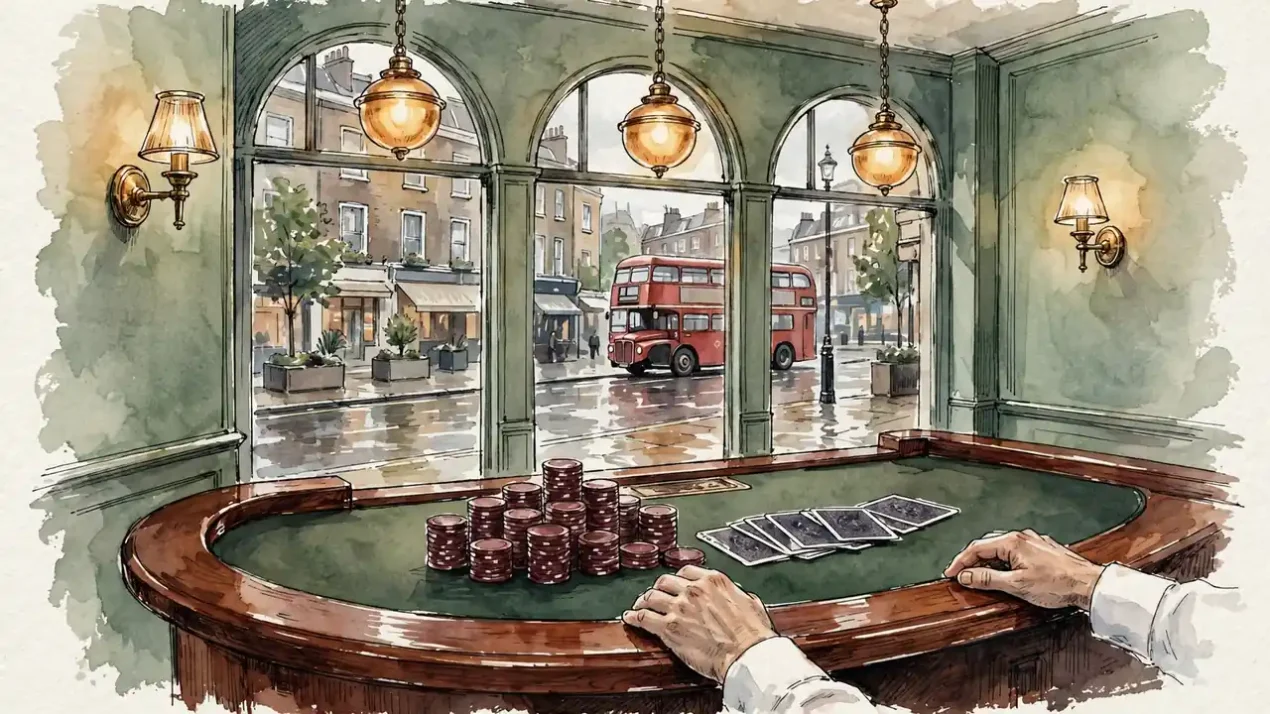
A practical guide to blackjack rules, live dealer tables, online play and the decisions that influence each hand.
How Casino Blackjack Works at the Table
Blackjack is a contest between each player’s hand and the dealer’s hand, not a general contest among the people seated around the table. The aim is to finish closer to 21 than the dealer without going over it. That small distinction gives the game its particular tension: another player’s decision may alter the cards that appear next, but it does not change that player’s own hand or result.
A round begins when wagers are placed and the dealer deals two cards to each position and two to themselves. The player’s cards are normally visible. One dealer card is shown, while the other remains concealed until the players have acted. Card values are straightforward: numbered cards retain their value, picture cards count as ten, and an ace can count as either one or eleven, depending on which value keeps the hand useful without exceeding 21.
The first important moment is the opening hand. A total of 21 made from an ace and a ten-value card is the strongest natural hand and is commonly treated differently from an ordinary 21 made over several cards. If neither side has such a hand, play proceeds around the table, one position at a time. The dealer waits. The player decides.
The basic choice is whether to stand, keeping the current total, or hit, asking for another card. Hitting can improve a modest hand, but it can also push the total beyond 21. That is a bust, and the hand ends immediately as a loss against the dealer. Standing avoids that immediate risk but leaves the existing total to face the dealer’s eventual hand.
A player may also double down in permitted situations: the wager is increased, one further card is taken, and the hand then stands. The attraction is obvious when the opening cards offer a promising position; the cost is equally obvious when the extra card disappoints. Some tables allow a hand to be split when the opening cards form a matching pair. The original hand becomes two separate hands, each receiving another card and each requiring its own decision. One decision has become two, which is blackjack’s quiet way of multiplying a dilemma.
UK Casino Games: Slots, Live Tables and More
The dealer’s turn follows the players. The concealed card is revealed, the hand is valued, and cards are drawn according to the table’s fixed dealing rules rather than personal judgement. This is a useful boundary: the player chooses how to manage risk, while the dealer follows the prescribed procedure. If the dealer busts, surviving player hands win. If the dealer remains in play, totals are compared. A higher total wins, a lower total loses, and an equal total is a push, returning the wager rather than producing a win or loss.
This structure explains why there is no reliable method to force a winning result in casino blackjack. Each decision changes exposure to risk, but neither judgement nor confidence controls the next card. The table offers choices, not influence over chance. In an online game, the same hand logic applies even when the table is represented on a screen rather than by felt, chips and a dealer’s upturned card.
Blackjack Rules, with the Great Britain Slot Limits Kept in Their Lane
Blackjack casino rules are built around one aim: finish closer to 21 than the dealer without going over. Number cards retain their face value, picture cards count as ten, and an ace can count as either one or eleven, depending on which value keeps the hand viable. The dealer follows the table’s fixed procedure, while the player chooses whether to take another card, stand, double, or split where the hand and table rules allow it.
A total above 21 is a bust and loses the hand. If the dealer busts while the player has not, the player wins; otherwise, the higher valid total prevails. Equal totals produce a push, normally returning the original wager. A natural blackjack — an ace with a ten-value card in the opening hand — is treated according to the table’s stated payout rules, which should be read before play.
The rules of blackjack at a casino are not the same thing as the rules for online slots. A specialist review reports that Great Britain’s slot stake controls set a ceiling of £5 per game cycle for adults aged 25 and over, and £2 for those aged 18 to 24. That account also says these limits do not extend to blackjack or roulette. They belong to the slot category, not to every game carrying a casino label. A neat distinction, for once.
Blackjack is a contest between each player’s hand and the dealer’s hand, not a general contest among the people seated around the table.
Other table conditions matter: whether the dealer stands or hits on a soft 17, how split aces are handled, and whether doubling after a split is permitted. Such details can change the decisions available without changing the central object of the game.
At market level, the UK Gambling Commission oversees gambling, including online casinos, and is the sole regulator of commercial gambling in Great Britain. Its remit covers remote gambling offered to Great Britain consumers even when essential equipment is located elsewhere. The Commission grants operating licences to gambling businesses and personal licences to relevant individuals. Before depositing, the operator’s licence number should be checked on the Commission’s public register.
Playing Blackjack Online: From Account Checks to the First Hand
Opening an account is less dramatic than the table it eventually leads to. The process begins with an operator that is permitted to offer remote gambling to people in Great Britain. Before any deposit is accepted, the casino must verify that the customer is aged 18 or over. Age verification is therefore not a box to tick after the first session; it is a condition of access to funded play.
Registration and account checks
The registration form normally asks for identifying and contact details, followed by checks designed to confirm the person behind the account. Information may need to be clarified before the account can be used fully. That pause is part of the framework, not an interruption invented by the live-dealer studio.
The Gambling Commission is the regulator for remote gambling offered to consumers in Great Britain, wherever the operator’s key equipment is located. A casino serving this market must hold the relevant operating licence. The licence number should be checked on the Commission’s public register before money is deposited. A polished front end is not a credential.
Best Keno Online Casinos UK: How the Game Works
New customers must also be prompted to set a financial limit before making their first deposit. Account-level controls should remain accessible afterwards, allowing spending boundaries to be reviewed rather than forgotten in the enthusiasm of registration. UK-licensed casinos must provide responsible-gambling tools, including self-exclusion, and must offer an internal complaints procedure with access to an approved Alternative Dispute Resolution service.
Depositing and selecting a table
Once the account is verified and a limit has been set, the next stage is funding it through an available payment method. Credit cards cannot be used for gambling at UK-licensed casinos. The restriction also covers credit-card funding routed through a money service business, and a digital wallet cannot be used for gambling where that wallet permits credit-card funds.
The practical consequence is simple: payment options shown at the cashier still have to be considered in light of how the money reached them. A method being visible does not make every funding route acceptable.
The casino lobby then separates live tables, automated blackjack and other casino games. A player looking to play Blackjack online can choose a table according to the displayed conditions, such as the available stake settings, before opening it. “Free play” may refer to a demonstration mode, where no real-money wager is placed; it does not turn a funded table into a risk-free one.
After the table loads, the opening hand begins under the game’s stated conditions. The account work is finished, but the financial boundary remains in force. Gambling should involve only money that can be afforded to lose.
DO
- Check the operator’s licence number on the Commission’s public register.
- Set a financial limit before making your first deposit.
- Use responsible-gambling tools like self-exclusion.
DON’T
- Use credit cards for gambling at UK-licensed casinos.
- Rely on a brand name as proof of a valid licence.
- Assume offshore licences are a substitute for British authorisation.
Live Dealers, Real Tables and the Long Arrival of Live Casino
A live dealer blackjack casino borrows its atmosphere from the room rather than from the software alone. The cards are handled at a physical table, a dealer appears on camera, and the action is transmitted to the online screen. The result is still remote gambling, but the visible source of the game is a person and a table, not an animated dealer generated entirely by a computer.
That difference matters because an automated blackjack game is built from code and digital graphics. Its cards, dealer movements and outcomes are presented within the software interface. A live table, by contrast, places the dealing process in front of cameras. The dealer gathers the cards, follows the table procedure and communicates through the broadcast, while the platform supplies the connection, interface and account records around it.
The distinction is not a promise that live play changes the mathematics of blackjack. It changes the social shape of the game. A silent automated screen can make a casino feel like a calculator with bright buttons. A live table restores some of the pauses, gestures and small rituals that have always made casino play a public performance: cards slide across felt, a dealer acknowledges the table, and several players occupy the same round without sharing the same room.
This is why the phrase “online live dealer blackjack” describes more than a technical delivery method. It points to a hybrid arrangement: the setting is physical, the access is digital, and the participants may be scattered across the United Kingdom or beyond. A player using real money is not entering the studio, yet the studio remains part of the experience. The screen is a window, not merely a decoration.
From casino floor to online table
Live casino did not appear fully formed with modern streaming. Its arrival followed the broader movement of gambling from dedicated premises into homes, where the old signs of a casino had to be reconstructed through cameras, microphones and an interface. The dealer became both croupier and presenter; the table became a set; the online lobby became the corridor between games.
Progressive Slots Online UK: How Jackpots Work
Grosvenor first introduced its live casino games in 2013. The launch included a selection of card and casino games, among them Blackjack, Texas Hold’em and Roulette. That range is revealing. Live casino was not conceived simply as an online copy of one table game. It was a format for bringing several recognisable casino rituals into a remote setting.
Blackjack suited the transition particularly well. Its rounds are easy to follow visually, its decisions occur in a clear sequence, and the dealer remains a visible centre of the table. Roulette offers another kind of spectacle, with the wheel turning in full view. Texas Hold’em places more emphasis on cards, players and the rhythm of a shared game. Together, these games helped establish live casino as a category rather than a single product.
The modern live dealer blackjack casino therefore sits between two histories. One belongs to the casino floor, with its tables, dealers and spectators. The other belongs to online software, with its instant access and carefully arranged interface. Neither side disappears. The physical table supplies the performance; the website supplies the doorway.
French Roulette Online Casinos in the UK
There is also a modest social fiction at work. Players appear together, but they remain alone in separate rooms, connected by a broadcast and a sequence of wagers. The arrangement is intimate enough to resemble a table and distant enough to remain unmistakably online. That contradiction is the form’s central charm.
A table, at a distance.
Recommended online casinos
- SpinFormulaBonus: 550% Up To £15,000 + 550 FS · Payout speed: 1-3 business days
- NightWinBonus: £900 + 400 free spins · Payout speed: 1-3 business days
- EvoSpinBonus: 125% up to €2500 + 125 Free Spins · Payout speed: 1-3 business days
- WinBeastBonus: €5000 + 500 FS + €650 Freebet · Payout speed: 1-3 business days
- DieselwinBonus: Welcome Pack 250% up to £4000 + 200 FS · Payout speed: 1-3 business days
- ZombillionBonus: Welcome Pack 250% up to £4000 + 200 FS · Payout speed: 1-3 business days
- ChanzeBonus: Slots Welcome Bonus #1 200% up to €500 · Payout speed: 1-3 business days
- BritsinoBonus: Welcome Package – Get your £2,200 + 2,000 FS · Payout speed: 1-3 business days
- NightLuckBonus: Welcome Pack + 805% Up To 6400€ + 280 FS · Payout speed: 1-3 business days
- AmunbetBonus: Join now and get 450% up to 2,700 GBP + 450 FS · Payout speed: 1-3 business days
Live Casino Games and the Company Behind the Table
A live casino is not defined by blackjack alone. The same studio or operator may place several tables and game types in one lobby, allowing the atmosphere of the card room to sit beside roulette, game-show formats and other casino amusements. For a player looking for a blackjack casino game in the UK, this wider setting matters because the choice is often between a table within a broad live portfolio rather than a self-contained blackjack room.
The familiar neighbouring games are roulette and baccarat, while some live menus move towards faster, more theatrical formats. Named examples include Lightning Roulette, Infinite Blackjack, Crazy Time and Dream Catcher. They do not all ask for the same kind of attention. Roulette turns on the wheel and its sequence of results; a game-show title adds presentation and changing bonus mechanics; blackjack keeps the centre of gravity at the table, where cards, dealer procedure and player decisions remain visible.
Live Baccarat Online Casino UK: How It Works
That distinction helps explain why “live casino games” is a more useful category than a list of table names. A casino Blackjack game may be offered in a conventional format, with a dealer handling cards for several seats, or as part of a more specialised presentation. Infinite Blackjack, for instance, is a named live product rather than a generic description. Its presence in a lobby tells more about the provider’s catalogue than about every blackjack table available there.
Providers are the companies that create and operate the game technology, while casinos present those games to their customers. Evolution is one provider associated with live casino products. NetEnt and Eyecon are also names encountered in the wider online-casino industry. This division is easy to overlook: the logo on a casino page may belong to the operator, while the studio identity, table design and broadcast infrastructure come from another company.
For UK players comparing blackjack casino games, provider recognition can therefore be a useful piece of information, but not a verdict. It may indicate which tables, interfaces or side offerings appear in the lobby. It does not, by itself, establish that a particular operator is suitable, that every game has identical rules, or that a table will match another table carrying the same broad label. The title is only the doorplate.
A broader live selection can also include products such as Common Draw, alongside roulette and game-show tables. That variety is part of the social promise of live casino: one screen contains several versions of chance, each borrowing something from the old rooms where casino games were arranged close together. The modern lobby merely makes the corridor digital.
Fast Payout Online Casinos in the UK: How They Work
For blackjack, the practical question is consequently less “which catalogue is largest?” than whether the available table is clearly described, visibly live and presented by an operator whose credentials can be checked. The range supplies context; it should not be mistaken for proof.
Choosing a Blackjack Casino Without Mistaking a Claim for a Credential
A casino can describe itself as established, secure or fully licensed. None of those descriptions is a licence. For anyone comparing blackjack casinos in the UK, the useful distinction is between what a brand says about its status and what can be checked independently before an account is funded.
The relevant public record is the register maintained by the UK Gambling Commission. The Commission is the authority responsible for commercial gambling in Great Britain, including remote gambling offered through online casinos. Its role is not decorative: it grants operating permissions to businesses and personal licences to individuals involved in running gambling operations. A remote operator serving customers in Great Britain therefore needs the appropriate Commission authorisation, even when its business or technical equipment is based elsewhere.
That makes the register the starting point for assessing blackjack online casinos UK players may encounter. A polished website, a familiar payment logo or a page carrying the words “UK licensed” cannot replace a record that identifies the authorised business.
Brand, domain and licence are different things
An online casino is often presented through several names at once:
- the public-facing brand;
- the legal company operating the service;
- the website domain;
- a licence holder shown in small print;
- a provider supplying the live table or software.
These identities may be related, but they are not interchangeable. A game provider can supply blackjack without operating the casino. A domain can display a brand name without proving which company accepts deposits. A corporate name in terms and conditions may not be the same as the name used in advertising.
The check therefore needs to connect the pieces. The register entry should correspond with the business named by the operator, while the website’s stated domain should also make sense in that relationship. A badge saying “licensed” is only a claim until the underlying details line up.
This is particularly important for casino blackjack because the live table can make a service feel unusually tangible. There may be a dealer, a studio setting and a continuous stream, yet the account, payment and customer relationship still belong to an online gambling operator. Atmosphere is not authorisation.
How to inspect the public register
A sensible review of blackjack casinos online begins with the operator’s legal information rather than its game lobby. The footer, terms, privacy notice or responsible-gambling pages may identify the company and licence number. Those details can then be checked against the Gambling Commission’s public register.
The examination should cover several points:
- The exact business name. A trading brand alone may not identify the licence holder.
- The licence category. The record should show permission relevant to remote gambling, not merely an unrelated form of gambling activity.
- The licence status. A number printed on a website does not establish that the authorisation is current.
- The connection with the domain. The registered business and the website should not appear to belong to unrelated entities.
- The scope of the service. The authorisation should make sense for the casino products being offered to Great Britain consumers.
The licence number should be verified on the public register before depositing. This is not a ceremonial final step. It is the point at which a marketing statement becomes a proposition that can be tested.
A register search can also expose a mismatch that the website leaves carefully blurred. The result may identify a legal entity rather than the brand, which is normal enough; the important question is whether the relationship is clear and credible. If the operator supplies only a trading name, a vague overseas company or an unverifiable licence reference, the uncertainty is itself relevant.
Why location does not settle the question
Some websites imply that regulation depends mainly on where the company is incorporated or where its servers sit. For British customers, that is not the decisive test. The Commission’s requirement applies to remote operators serving Great Britain consumers regardless of where the key equipment is located.
The same principle prevents a foreign licence from being treated as a substitute for British authorisation. An offshore casino may operate under another jurisdiction’s system, but that does not place it inside the UK Gambling Commission framework. For blackjack casinos UK players can legally use, the relevant question is whether the service selling into Great Britain holds the required local operating licence.
This is why a casino’s “international” status should not be mistaken for a qualification in the British market. Geography can explain a company’s structure; it cannot erase the regulatory obligation attached to its customers.
A live table does not make a weak claim stronger
Live blackjack online casinos often emphasise the studio, the dealer and the table interface. Those features describe the product, not the operator’s legal standing. The same applies to statements about fair dealing, professional presentation or technical security. They may be worth examining, but they answer different questions.
A useful assessment separates at least four layers:
- Regulatory standing: whether the operator appears with the appropriate current authorisation.
- Identity: whether the company behind the brand and domain is disclosed consistently.
- Game provenance: whether the live table is supplied by a named provider or operated by the casino itself.
- Account safeguards: whether the service presents the controls and complaints routes expected of a licensed operator.
The first layer is foundational. Without it, the rest becomes a collection of impressions. A beautifully produced blackjack stream remains a stream offered through an account relationship that needs a lawful operator behind it.
The difference can seem pedantic until money is involved. Then it becomes the difference between a claim visible on a landing page and an entry that can be checked in a public record. Paperwork is less glamorous than a dealer in a studio, but it has the advantage of existing outside the advert.
What the register can and cannot prove
A register check is powerful, but it is not a review of the quality of every table. It can help establish whether a business holds the relevant operating permission and whether the supplied details correspond with the regulated framework. It does not by itself determine whether a particular blackjack table is enjoyable, whether its interface is clear or whether a player prefers one provider’s presentation to another.
Nor does a licence make every promotional statement true. Claims about availability, payment methods, customer service or game choice still need to be read in the operator’s own terms. Licensing is a threshold question, not a five-star rating.
The reverse is also true: a casino may have an appealing lobby and an apparently professional service while leaving its regulatory identity unclear. That uncertainty should not be polished away with language such as “trusted”, “official” or “safe”. Those words describe reputation, or an attempt to create one. They do not identify an entry on the register.
A caution about LuckyPays
A specialist review reported that a search of the Gambling Commission register dated 26 September 2026 did not show a LuckyPays entry under that brand or the stated domain, including luckypays.io. That is a time-specific finding, not a permanent description of the market. Register information can change, and a review is not a substitute for checking the current official record.
Classic Slots Online UK: Reels, Symbols and Play
The practical lesson is broader than that single name. When a casino presents itself as suitable for British customers, the claim should be tested against the live register using the operator’s legal details, brand and domain. If those elements cannot be reconciled, the site has not supplied the clarity needed for a confident assessment.
A brand can be absent under its trading name while appearing under a corporate name, so a superficial search should not be treated as conclusive. The sensible response is to examine the operator’s terms and licence details, then search those precise details. If no relevant record emerges, the gap should remain a gap rather than being filled with assumptions.
Signs of a credible operator
The assessment becomes more reliable when several public-facing details agree. A credible UK blackjack casino should make it possible to identify the operating business, locate its licence information and understand which domain serves the account. Its terms should not make the corporate identity impossible to follow.
The site should also present ordinary regulatory information without treating it as a secret reserved for persistent investigators. A licensed operator is expected to have an internal complaints route and access to an approved Alternative Dispute Resolution service. It should provide responsible-gambling tools, including self-exclusion, and allow account-level controls to be found without an archaeological expedition through the menu.
These features do not prove that every customer-service interaction will be pleasant. They do show whether the operator acknowledges the obligations attached to its licence. The Research, Education and Treatment levy is another part of that regulated structure: licensed operators are required to contribute to it. Such arrangements are less visible than a welcome screen, but they reveal what sits behind the brand.
The strongest signs are therefore documentary:
- a named legal operator;
- a relevant and current register entry;
- a clear relationship between company, brand and domain;
- accessible complaints and dispute information;
- visible responsible-gambling controls;
- terms that explain the service rather than merely decorate it.
No single visual badge can perform all those functions.
Questions worth settling before choosing a table
The choice among UK Blackjack casinos need not become a ranking exercise. It is more useful to ask whether the basic facts survive inspection.
Who is accepting the account?
The legal entity should be identifiable, not hidden behind a brand alone.
Does that entity appear on the Gambling Commission register?
The licence number and business name should be checked directly rather than copied from an advert.
Does the authorisation match the service?
A casino offering remote blackjack to Great Britain consumers needs the appropriate operating permission for that activity.
Is the stated domain connected to the registered business?
A mismatch may have an innocent explanation, but it should be clarified before funds are placed.
Are complaints and safeguards visible?
A regulated service should explain its complaints process, ADR access, self-exclusion and account controls.
Are claims about the table being confused with claims about the casino?
A provider’s reputation or a dealer’s presentation does not establish the operator’s licence.
This method also keeps the comparison honest. It does not call one operator “best” on the basis of an unverified list, and it does not turn a provider catalogue into a judgement about account safety. It asks a narrower, more answerable question: can the casino’s identity and regulatory position be demonstrated?
The cost of accepting an easy label
The phrase “licensed casino” is convenient because it compresses a complicated relationship into two words. Convenience is precisely why it deserves checking. Online blackjack offers a particularly persuasive stage: cards appear to move in real time, dealers speak to a room of players and the brand can borrow the authority of a physical casino. None of this removes the need to identify the remote operator.
Essential Verification
A public register check is the only way to turn a marketing claim into a verifiable proposition.
For British players, the relevant boundary is clear. Online gambling is lawful through operators holding the required UK Gambling Commission licence; offshore services outside that system are not transformed into British-licensed casinos by accepting British visitors. The player is not responsible for making an offshore operator compliant, but the absence of local authorisation remains a material warning when assessing the service.
A public register cannot tell anyone which table has the most congenial dealer. It can answer a more basic question: whether the business claiming a place in the British market has a corresponding regulatory record. That is where evaluation should begin, and where unsupported confidence should end.
Any live blackjack choice also belongs within a personal financial limit. Gambling should be restricted to money that can be afforded to lose, with the operator’s available controls used when play begins to feel less like entertainment and more like an obligation. A licence is a credential for the operator. It is not a promise of profit, and certainly not a permission to ignore the cost.
Blackjack Strategy: Decisions, Not Guarantees
Blackjack strategy is best understood as a method for making repeated decisions, not as a charm against bad luck. A live table may make the cards feel more personal: a dealer visible on screen, other hands unfolding beside the player’s, the small theatre of pauses and gestures. None of that changes the mathematical uncertainty of the next card. Strategy gives that uncertainty a consistent response.
The central discipline is to judge the player’s hand alongside the dealer’s visible card. A strong-looking total may still call for caution when the dealer’s card is favourable. A modest total may require another card when standing would leave too much ground to recover. The point is not to follow instinct whenever a hand feels uncomfortable. It is to replace mood with a prepared decision.
What a strategy table is doing
A basic blackjack strategy table translates two pieces of information into an action:
- the value and character of the player’s hand;
- the dealer’s exposed card.
It then indicates whether hitting, standing, doubling or splitting is the more defensible choice under the table’s rules. This is not a prediction of the individual hand. It is a long-run decision framework, designed to avoid common inconsistencies such as standing because a previous hand lost or taking another card because the table has been quiet.
The framework also separates hard hands, soft hands and pairs. A soft hand contains an ace that can change value without immediately making the hand bust; a pair may create a different opportunity from the same total held as two unlike cards. These distinctions matter because the safest action is not determined by the total alone.
In live blackjack, attention can drift towards the dealer’s manner, a neighbouring player’s wager or a dramatic run of cards. None supplies reliable evidence about the next deal. A strategy remains useful precisely because it ignores the table’s mythology. It cannot alter the cards, remove the house edge or guarantee a profitable session. It can only make the reasoning less erratic.
That limitation is not a flaw. It is the honest boundary between skill and chance. Strategy helps answer what action is most defensible in a given situation; it does not promise that the chosen action will win. Losses remain possible, and the sensible boundary is to gamble only what can be afforded to lose.
Fastest Payout Online Casinos in the UK: What to Check
Bonuses, Bitcoin and the Limits of the Offer
A blackjack casino bonus can look generous while saying very little about what can actually be withdrawn. The important document is the offer’s full wording, not the headline. It may restrict which games contribute to the promotion, exclude live tables, require particular payment methods, or impose conditions on withdrawing funds. A phrase such as “casino blackjack bonus” describes a marketing category, not a promise that every hand will qualify.
The same caution applies to a no-deposit offer. A blackjack casino no deposit bonus may be presented as a way to try a game without making an initial payment, yet the terms can still govern eligibility, identity checks, play requirements and withdrawals. “No deposit” does not mean “no conditions”. It is a small phrase carrying rather more luggage than it admits.
A UK-facing offer should also be read alongside the operator’s account safeguards. Remote operators must prompt new customers to set a financial limit before the first deposit and provide account-level controls for changing it. That limit is not a promotional feature, and a bonus should not be allowed to turn it into an afterthought. Credit cards cannot be used for gambling, including through a money service business, and a wallet cannot be used where it permits credit-card funds to finance gambling. A payment logo is therefore not proof that every route shown in an advert is available for a gambling transaction.
Live Dream Catcher Casino UK: Game and Site Guide
Bitcoin deserves the same degree of scepticism. A casino may mention cryptocurrency without establishing that bitcoin deposits or withdrawals are accepted for a particular account, table or promotion. Payment availability, verification requirements and bonus eligibility belong to the operator’s current terms. No particular casino should be assumed to accept bitcoin merely because the currency appears in general casino advertising.
The sensible reading of a blackjack casino bonus offer is therefore administrative rather than celebratory: identify eligible games, payment restrictions and withdrawal conditions before funds are committed. Promotional language can invite the first click. The terms decide what follows.
Blackjack in the UK: A Live Game in a Regulated Market
Live blackjack sits between two systems that are easy to confuse. The first is the game itself: cards, dealer procedure, table decisions and the particular rules attached to a table. The second is the online setting in which that table is offered: licensing, identity checks, payment controls and tools intended to keep gambling within manageable bounds. A live stream may make the first system feel almost old-fashioned. The second is distinctly modern, and rather more consequential.
For a Blackjack casino UK players can use legally, the operator must hold the relevant Gambling Commission licence. The UK Gambling Commission regulates commercial gambling in Great Britain and is the sole regulator for that activity there. Its remit covers remote gambling offered to consumers in Great Britain even when the equipment supporting it is located elsewhere. That is why a polished website, a familiar game name or a convincing licence claim is not enough. The licence number belongs on the Commission’s public register.
Jackpot Mobile Casinos UK: Types, Rules and Odds
That check should come before a deposit, not after a dispute. UKGC licensees must provide an internal complaints route and access to an approved Alternative Dispute Resolution service. They must also offer responsible-gambling measures, including self-exclusion. These are not decorations around the table; they are part of the conditions under which a UK Blackjack casino operates.
Account controls have a quieter role. Remote operators must prompt new customers to set a financial limit before the first deposit and make account-level limit tools available. Self-exclusion can provide a firmer pause, while GAMSTOP offers a national self-exclusion route for participating licensed online gambling sites. Neither tool changes the odds of a hand. Both can change whether another hand is placed at all.
Payment restrictions belong to the same protective framework. UK-licensed casinos cannot accept credit cards for gambling, including credit-card funding passed through a money-service business or a wallet that permits credit-funded gambling. The absence of a familiar payment route is therefore not, by itself, evidence of a faulty Blackjack online casino.
The sensible final test is plain: verify the licence on the UKGC register, set limits before play, use self-exclusion where necessary, and gamble only what can be afforded to lose. The dealer controls the cards. The surrounding safeguards control the circumstances.
What are the online slot stake limits in Great Britain?
The limits are £5 per game cycle for adults aged 25 and over and £2 for adults aged 18 to 24. They apply to online slots, not blackjack or roulette.
Are online casino games licensed and regulated?
Yes. The UK Gambling Commission regulates online gambling offered to consumers in Great Britain, and remote operators serving them must hold the relevant licence.
Is LuckyPays licensed by the UK Gambling Commission?
The Commission’s public register dated 26 September 2026 does not list LuckyPays under its brand or stated domain, luckypays.io.
How do I check if an online casino is licensed in the UK?
Check the operator’s licence number against the UK Gambling Commission’s public register before depositing.
Related posts

Terms of Use

Top Rated Online Casinos UK: What Ratings Mean