
Online Casino European Roulette in the UK: How It Works
 Available in GB
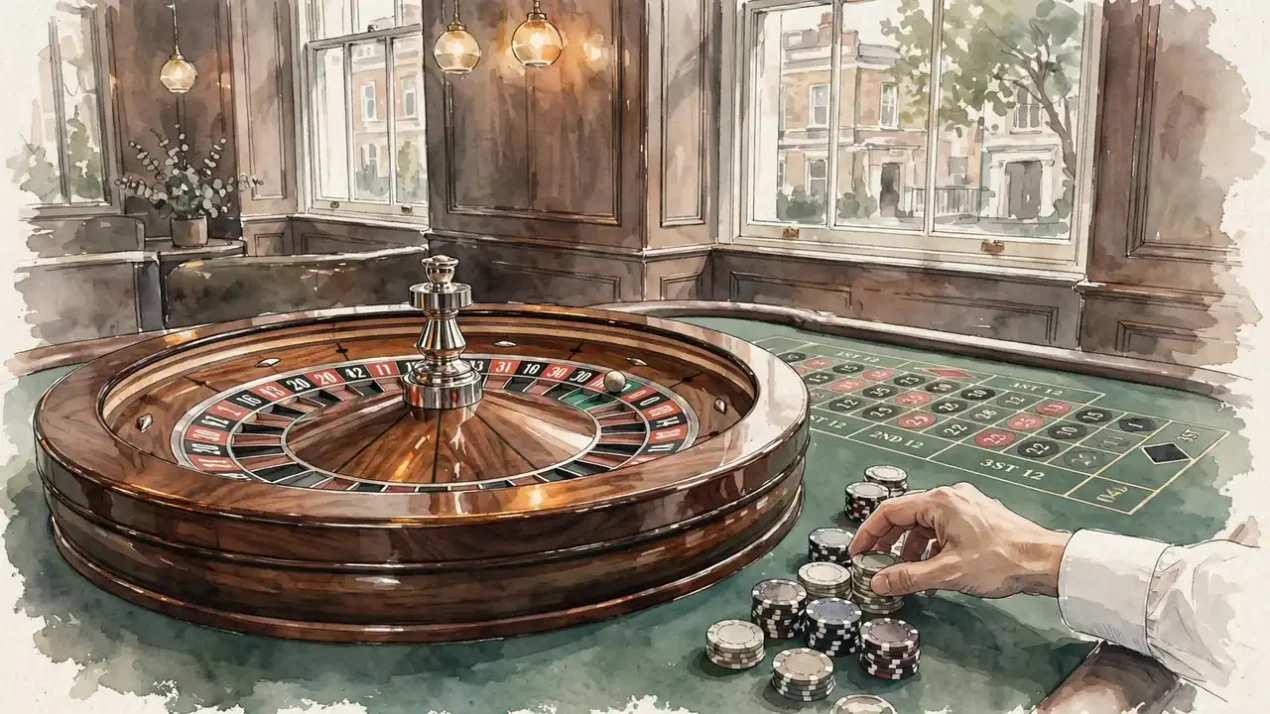
A guide to the single-zero layout, bet types, online formats and the practical differences between European and American roulette.
The European Wheel: One Zero, One House Edge
European roulette is built around a wheel with 37 pockets. Thirty-six carry the numbers 1 to 36; the remaining pocket is green and marked zero. That small green interruption is the feature on which the mathematics of the game rests. Remove it and the wheel would be a contest between two equal sets of numbered outcomes. Include it, and the casino acquires its margin.
The numbered pockets are arranged around the rim rather than displayed as a simple sequence. A ball travels in the opposite direction to the wheel before losing speed and dropping into one pocket. Online versions reproduce this central event through software or a streamed physical wheel, but the single-zero European design remains the same: 37 possible landing positions, one of them outside the numbered run.
Why one pocket changes everything
A straightforward number bet illustrates the relationship. A chosen number occupies one of the 37 pockets, so its chance of appearing is one in 37. If it wins, the standard return is 35 to 1. The payment reflects the winning number but not the zero’s presence. That difference between the number of possible outcomes and the size of the payout creates the casino’s advantage.
Across a large number of spins, the mathematical house edge for European roulette is 2.70%. It is not a prediction about the next result, nor a statement that every short session will follow a neat pattern. It is the long-run cost built into the wheel’s structure. The green zero does not need to appear often in any memorable sequence to matter; its place in the complete set of outcomes is enough.
This is why the European wheel should not be described merely as a table of numbers. It is a compact probability machine. Every stake is exposed to all 37 pockets, even when it is placed on a particular number or group. The zero is the quiet extra possibility that prevents the standard winning payments from matching the full odds.
UK Casino Games: Slots, Live Tables and More
European means single zero
The name “European roulette” identifies the single-zero layout. The wheel contains numbers 1 through 36 and one zero, making 37 pockets in total. That distinguishes it from American roulette, which adds a second green pocket marked 00 and therefore has 38 pockets. The extra pocket changes the calculation rather than decorating the wheel.
For the same straight-up number bet, both variants pay 35 to 1. Yet the American wheel gives the selected number one chance in 38 instead of one in 37, while the payment remains unchanged. Its house edge is 5.26%, compared with 2.70% on the European wheel. The difference is produced by one additional green space. Casino mathematics is rarely sentimental; it notices every space.
The comparison also explains why a British online casino may label a game carefully. “Roulette” alone does not identify the wheel’s probability model. The European version, whether presented through an online casino or a live table, has the single-zero arrangement. American roulette has the double-zero arrangement. The visual resemblance can conceal a meaningful difference in the underlying odds.
What the edge does — and does not — say
A 2.70% house edge is a statistical measure, not a forecast of an individual session. It does not mean that a particular sequence will lose exactly that share, or that the zero must appear at a regular interval. Random results can cluster, alternate or look strangely orderly for a while. None of those appearances changes the composition of the wheel.
Nor does the single zero create a pattern that can be decoded. The result of one spin does not instruct the ball where to land on the next. A run of red outcomes does not make black “due”, and a number absent for a long time has acquired no debt to the table. Roulette has a talent for making random events look like unfinished stories.
That is also why betting systems cannot remove the edge. A staking method may alter the size and timing of wins and losses, but it cannot remove the green pocket or change the number of possible outcomes. The Martingale system, for instance, doubles a bet after each loss; a losing streak can then place increasing pressure on a bankroll without changing the wheel’s probabilities. No strategy can predict the final outcome, because roulette results are determined by chance.
Wheel Type
European (Single Zero)
Total Pockets
37
House Edge
2.70%
Standard Payout
35 to 1
The European wheel’s essential facts are therefore plain: 37 pockets, one zero and a 2.70% house edge. Everything else — the colour of the cloth, the speed of the animation, the solemnity of a live dealer — comes later. The arithmetic starts with that single green pocket.
Finding a UK Casino That Offers European Roulette
A search for European roulette casinos in the UK is really a search for two things at once: a particular table and a lawful route to it. The distinction matters because a polished game lobby can conceal a jurisdictional problem. For British players, the first question is not whether the wheel looks elegant, whether the table carries a VIP label or whether a promotional banner promises distinction. It is whether the operator is permitted to provide remote gambling in Great Britain.
The UK Gambling Commission (UKGC) is the sole regulator of online casino activity in Great Britain. Remote gambling operators selling into the British market must hold the relevant UKGC licence, wherever the business itself is based. A platform without a valid UKGC licence cannot legally offer real-money live roulette to British residents. That rule applies just as firmly to European roulette online casinos as it does to any other casino game.
Start with the licence
The licence should be checked before registration, not after a deposit has been made. A casino may display a regulatory statement in its footer, but a statement on a webpage is not the same thing as confirmation on the UKGC public register. The operator’s name, trading identity and licence status should correspond with the register. Any mismatch deserves a pause rather than a charitable interpretation.
Online Casino Tournaments in the UK: Formats and Rules
This is especially important when a site presents itself as serving several countries. An offshore casino may be accessible from Britain and may offer European roulette, European VIP roulette or a broad catalogue of online games. Accessibility, however, does not turn an offshore operator into a UKGC-licensed operator. British gambling law places the licensing duty on the operator offering the service, not on the player using it.
A lawful casino should also make its terms available in a form that can be read before play begins. The pages covering registration, deposits, withdrawals, complaints and account restrictions should identify the responsible business clearly. Vague ownership details are not an attractive mystery. They are a practical obstacle if an account dispute later arises.
Age checks come before funding
Operators must verify a customer’s age before allowing that customer to deposit funds into a gambling account. Age verification is therefore part of access, not an optional courtesy added after a first session. A site that appears eager to accept a deposit while treating identity checks as an inconvenience is not demonstrating flexibility; it is failing at a basic safeguard.
The same principle applies to account information. Details supplied during registration may need confirmation before gambling is enabled, and the process can involve checks intended to establish identity as well as age. A serious operator explains what is required and why. The paperwork is less glamorous than the roulette table, but it is the part that determines whether the account has a lawful beginning.
Do
- Check the UKGC licence on the public register
- Verify your age before depositing funds
- Set financial and session limits
Don’t
- Use an offshore operator without a UKGC licence
- Rely on betting systems to remove the house edge
- Assume a run of results makes another outcome “due”
Look for protections before the first spin
UKGC-licensed live casino operators must provide a defined set of player-protection tools. These include deposit limits, loss limits, session-time reminders, reality checks, cool-off periods and GamStop self-exclusion. The tools should be visible in the account area rather than buried in an obscure help page.
Remote operators must prompt new customers to set a financial limit before the first deposit and provide accessible account-level controls for changing limits. This makes the opening stage a moment of deliberate choice instead of a frictionless passage from curiosity to funding. Gambling systems are often designed around continuity; a limit interrupts that continuity in a useful way.
Self-exclusion should be treated as a serious account function, not as decorative responsible-gambling language. UKGC-licensed casinos must provide responsible-gambling tools, including self-exclusion, while GamStop offers industry-wide self-exclusion across participating licensed operators. Cool-off periods and reality checks serve a different purpose: they create space during play, when time can otherwise become strangely weightless.
Payment rules are part of the same protective framework. UKGC-licensed casinos cannot accept credit cards for gambling, including credit-card funding routed through a money service business. They also cannot accept wallet payments where the wallet permits credit-card funds to be used for gambling. A European roulette table may be the visible product, but the payment route reveals how closely the operator follows the rules.
Finally, UKGC licensees must offer an internal complaints process and access to an approved Alternative Dispute Resolution service. That information should be easy to find before an account is opened. The presence of a complaint route does not promise that every disagreement will be resolved in one direction; it establishes where the disagreement can go.
French Roulette Online Casinos in the UK
The sensible order is plain: confirm the UKGC licence, establish the operator’s identity, complete age verification, inspect the protection tools and understand the payment restrictions. Only then does the question of which European roulette table to open become relevant. Safeguards first. The wheel can wait.
Recommended online casinos
- SpinFormulaBonus: 550% Up To £15,000 + 550 FS · Payout speed: 1-3 business days
- NightWinBonus: £900 + 400 free spins · Payout speed: 1-3 business days
- EvoSpinBonus: 125% up to €2500 + 125 Free Spins · Payout speed: 1-3 business days
- WinBeastBonus: €5000 + 500 FS + €650 Freebet · Payout speed: 1-3 business days
- DieselwinBonus: Welcome Pack 250% up to £4000 + 200 FS · Payout speed: 1-3 business days
- ZombillionBonus: Welcome Pack 250% up to £4000 + 200 FS · Payout speed: 1-3 business days
- ChanzeBonus: Slots Welcome Bonus #1 200% up to €500 · Payout speed: 1-3 business days
- BritsinoBonus: Welcome Package – Get your £2,200 + 2,000 FS · Payout speed: 1-3 business days
- NightLuckBonus: Welcome Pack + 805% Up To 6400€ + 280 FS · Payout speed: 1-3 business days
- AmunbetBonus: Join now and get 450% up to 2,700 GBP + 450 FS · Payout speed: 1-3 business days
What Makes a European Roulette Casino a Good Fit
A suitable European roulette casino is not necessarily the one with the loudest welcome offer or the longest game lobby. The useful question is quieter: does the operator make the important conditions visible before money enters the account? A clear presentation of the roulette game, its rules, return information and account controls says more than a banner promising excitement.
RTP information should be easy to find
The return-to-player figure belongs near the game rules, not buried in an unrelated help page. For European roulette, the theoretical RTP is 97.30%, corresponding to a 2.70% house edge. That figure describes the game over a large number of spins; it is not a forecast for one session and cannot turn chance into a method.
A UKGC-licensed operator should make the game’s RTP information accessible. The same page should identify whether the table is European roulette, rather than leaving the wheel type to be inferred from a thumbnail. A single zero is a material detail, not decorative table scenery. Rules should also explain the available bets and payouts in plain language, with no need to reconstruct them from a promotional slogan.
A page that hides the rules behind registration is making the visitor pay in attention before being allowed to inspect the product. That is not a mark of quality.
RTP
For European roulette, the theoretical RTP is 97.30%, which corresponds to the 2.70% house edge.
Limits should be visible before play
Account controls are part of the casino’s design, not an emergency brake added after a difficult evening. Remote operators must prompt new customers to set a financial limit before the first deposit, and account-level limit controls must remain accessible afterwards. A sensible assessment therefore checks whether limits can be found without searching through several layers of menus.
UKGC-licensed live casino operators must offer deposit limits, loss limits, session time reminders, reality checks and cool-off periods. They must also provide GamStop self-exclusion. These tools do not alter the wheel’s mathematics, but they alter the circumstances in which a person can continue playing. That distinction matters: responsible gambling is not a strategy for beating roulette.
The wider payment framework belongs in the same inspection. UKGC-licensed casinos cannot accept credit cards for gambling, including credit-card funding routed through a money service business. Wallet payments are also barred where the wallet permits credit-card funds to be used for gambling. A casino that explains these boundaries clearly is easier to assess than one that leaves payment conditions to scattered terms.
Support should be more than a contact form
A good fit has support that can be reached before a dispute becomes a crisis. UKGC licensees must provide an internal complaints process and access to an approved Alternative Dispute Resolution service. Responsible gambling support should be visible alongside ordinary account assistance, with self-exclusion and limit controls treated as normal account functions rather than shameful exceptions.
The operator must also contribute to the Research, Education and Treatment levy. That obligation does not make every game suitable for every person, but it forms part of the regulated structure surrounding British online gambling. The National Gambling Helpline, GamCare and BeGambleAware are separate help services that may be relevant when gambling has stopped feeling recreational.
Online Casino Without ID in the UK: What It Means
The licence is a threshold, not a recommendation
The UK Gambling Commission is the sole regulator of online casino activity in Great Britain. Any operator selling remote gambling to British consumers must hold the relevant UKGC licence, and the licence number should be checked on the Commission’s public register before depositing. A platform without a valid UKGC licence cannot legally offer real-money live roulette to British residents.
This check is not a ranking exercise. It does not identify the “best” European roulette casino, because suitability depends on the clarity of the rules, the visibility of RTP information, the quality of controls and the availability of support. It establishes something more basic: whether the table belongs within the legal framework at all.
From First Spin to Payout: Playing European Roulette
A European roulette round online follows a simple sequence. A stake is placed before betting closes, the wheel is spun, and the ball settles into one of the pockets. The winning pocket determines which bets remain on the table and which are paid. Any losing stakes are removed, while winning stakes return according to the terms attached to the position chosen.
That sequence is the same whether the game is played in demo mode or for real money. The difference is what the balance represents. Free roulette is useful for becoming familiar with the buttons, the timing of a round and the way wins are displayed. It does not reproduce the financial consequences of a cash wager. Real-money European roulette turns each selection into a debit, a possible return, or both.
A typical round
Step 1: Place your stake
Select a chip value and place it on your chosen number or group before the betting window closes.
Step 2: The spin
The wheel is spun and the ball is released. In live games, a dealer manages this process.
Step 3: Settlement
The ball lands in a pocket. Winning bets are paid out according to the table odds, and losing stakes are removed.
Placing a round
The betting area normally accepts chips or stake buttons assigned to different values. A player selects a value, places it on the desired area, and can often adjust or repeat the previous round before betting closes. The interface then shows the total stake and the positions covered.
The ball’s result is not changed by how many selections are made. A single number, several number positions or a broader colour selection all face the outcome produced by the wheel. No system can identify the final pocket in advance; roulette remains a game of chance rather than a puzzle whose answer emerges through persistence.
Once betting closes, the spin takes place. In an automated game, software generates the result; in a live table, a dealer conducts the physical spin. The screen then marks the winning pocket and settles each wager. Some games show a short win animation, but the accounting is less theatrical: losing bets disappear, and qualifying returns are added to the balance.
How payouts appear
The clearest example is a straight-up wager on one number. If that number wins, the payout is 35:1 in both European and American roulette. A stake of one unit therefore produces 35 units in winnings, with the original stake returned separately under the usual display convention. If another pocket wins, the wager loses.
Broader outside selections pay less because they cover more possible results. Red and black, even and odd, and high and low each pay 1:1. A one-unit winning stake produces one unit in winnings, alongside the returned stake. The zero is the awkward exception to the neat symmetry of those choices: it is neither red nor black, neither even nor odd, and neither high nor low. The green pocket has a talent for spoiling tidy categories.
Online Bingo UK: Bingo Rooms and Casino Games
The payment panel may describe returns as “win”, “payout” or “total return”. These labels are not always interchangeable. A displayed payout can mean the profit alone, while a total return can include the original stake. Checking the table’s paytable before placing a wager prevents a harmless interface convention from becoming a costly misunderstanding.
When the round ends
After settlement, the balance updates and the table opens for another betting phase. Some interfaces offer a repeat or re-bet control; using it does not alter the odds or create a special status for the previous result. A run of red pockets does not make black more likely, and a losing round does not make the next spin “due”.
For anyone learning how to play European roulette, the practical order is therefore modest: select a stake, choose a position, confirm the wager, watch the result, and read the settlement. The detailed positions on the cloth come next.
Inside Bets, Outside Bets and the Single-Zero Layout
The European roulette table is arranged around the numbers 1 to 36, with one additional green space for zero. That single-zero layout gives the cloth its familiar shape: a long numbered grid, bordered by broader betting areas. The distinction is practical rather than decorative. A chip placed within the grid selects a narrow group of numbers; a chip placed beyond it covers a broader category.
European roulette inside bets
Inside bets sit on, between or alongside the numbered squares. They are number-focused choices, useful when a wager is intended to cover a small part of the layout rather than a large class of outcomes.
Split Bet
Occupies the line between two adjacent numbers with a 17:1 payout.
Street Bet
Covers a horizontal row of three numbers with an 11:1 payout.
Straight-up Bet
A single number selection paying 35:1.
A split bet occupies the line between two adjacent numbers. If either number appears, the payout is 17:1. Its position on the cloth mirrors its purpose: two neighbouring squares, one compact claim.
A street bet covers a horizontal row of three numbers. The chip is placed at the end of that row, and a winning result from any of its three numbers pays 11:1. The table therefore acts almost like a map legend; the chip’s location tells the game which territory has been selected.
Other inside positions can be formed around individual numbers or small clusters. Their common feature is concentration. Fewer covered numbers mean a more specific result is needed, while the listed payout reflects that narrower selection. The single green zero remains outside the numbered grid, so it is not silently included in a split or street position.
European roulette outside bets
Outside bets occupy the wider bands around the grid. They do not target a particular number. Instead, they divide the numbered field into broad groups: red or black, even or odd, and high or low.
Each of these pays 1:1 when the relevant condition is met. A red wager wins on a red number; an even wager wins on an even number; a high wager covers the upper half of the numbered range. The zero is the awkward little exception built into the design. It is neither red nor black, neither even nor odd, and neither high nor low. When zero appears, those corresponding outside bets do not win.
This is why an apparently balanced choice is not the same as an even chance. The single green pocket interrupts every one of these paired categories. The European roulette house edge is 2.70%, and the layout makes its cause visible without any theatrical arithmetic: one outcome belongs to neither side.
Choosing a position on the cloth
European roulette betting options differ chiefly in how tightly they gather outcomes. Inside bets trace small sections of the numbered grid and offer the quoted payouts for those specific groupings. Outside bets spread across wider categories and return even-money winnings when the selected condition appears.
Live Dream Catcher Casino UK: Game and Site Guide
Neither position changes the wheel’s composition. A chip may occupy a precise corner or a broad band, but the single zero remains part of every spin. The cloth offers order; chance supplies the final decision.
The Wheel Behind the Online Game
The same European wheel can arrive on screen by two quite different routes. In an RNG game, software uses a random number generator to simulate each spin. In a live dealer game, a camera streams a physical wheel from a studio, where a human dealer releases the ball and manages the round. The green zero remains part of the European wheel in either format; what changes is the machinery, tempo and atmosphere surrounding it.
RNG roulette: the compact machine
RNG roulette is built for immediacy. The software produces the result, settles winning bets and opens the next round without waiting for a dealer to gather chips or launch another ball. This makes it the faster choice for someone looking for a European roulette casino wheel without the studio presentation.
The financial threshold can also be lower. RNG roulette may be offered with minimum stakes as low as 10p, a detail that matters more than glossy graphics when a bankroll is modest. It is a private, compressed version of the table: no dealer’s voice, no physical ball drop, and no pauses created by a real room.
That absence is not a defect in the mathematics. The random number generator determines the result rather than a visible wheel, but the game still presents the familiar single-zero format when it is labelled European roulette. The screen is simply the delivery system.
Live roulette: a wheel on camera
Live dealer roulette restores the theatre that software removes. A real European roulette wheel turns in a studio, a physical ball completes its arc, and a human dealer announces the result before clearing the table for the next round. The streamed image supplies the small rituals of casino play: the wheel’s motion, the dealer’s timing and the pause in which bets close.
Online Slots Payout Percentage: What RTP Means
UK live roulette tables can start at 10p, while auto-roulette and speed formats sometimes begin at 5p, according to a specialist review. Those figures are table-specific rather than a promise attached to every casino with European roulette. A live table also tends to ask for more patience. A specialist review places speed roulette above 150 spins per hour, against 80–100 at a standard table. Speed, in other words, is not the same thing as live presence.
Auto-roulette sits between the two models. It uses a physical wheel but automates the handling around it, reducing the human pauses without turning the result into a software simulation. The distinction can matter to players who want to see a European roulette wheel with its green zero while keeping the round moving.
Choosing between formats is therefore less about one wheel being “real” and another being “fake” than about what is being purchased: rapid repetition from an RNG, or the slower social ceremony of a studio wheel. Both can deliver European roulette; only one puts a dealer between the ball and the screen.
Reading the Roulette Table
The European roulette table is arranged as a compact map rather than a picture of the wheel. Its centre is a numbered grid, while the surrounding boxes group numbers according to shared characteristics. Every position has a practical meaning: some cover one number, others several, and the broadest areas cover whole classes of outcomes.
The grid contains the numbers 1 to 36, with the single zero set apart in its own green space. That gives the European layout 37 pockets altogether. The zero is visually separated from the numbered columns because it does not belong to red or black, odd or even, low or high. Its solitary position is the table’s small reminder that neat categories always leave something outside them.
The numbered grid
The main grid is read in three-number rows and vertical columns. A number-focused selection can be placed directly on one square or across the lines separating neighbouring squares. The table therefore records not only the chosen numbers but also the size of the area covered by a bet.
The layout makes this hierarchy visible:
- one square represents a single number;
- a shared edge can connect two adjacent numbers;
- a horizontal row contains three numbers;
- a column runs vertically through the grid.
This visual structure helps distinguish a precise choice from a broader one without requiring a separate explanation beside every betting position. The closer the marker sits to an individual square, the narrower the selection tends to be.
The outside areas
Beyond the numbered grid are the outside-bet boxes. These commonly divide the numbers by colour, parity and range: red or black, even or odd, and low or high. Their larger rectangles signal wider coverage rather than a particular pocket.
Red and black areas correspond to colours printed in the grid, while even and odd areas sort the numbered outcomes mathematically. High and low areas divide the numbered sequence into two ranges. The zero remains outside these paired categories, even when it sits beside them on the cloth.
A European roulette casino table layout is therefore a piece of visual shorthand. The grid narrows the choice; the outside bands widen it. That does not create a winning system: a roulette strategy cannot predict where the ball will finish, because the outcome is determined by chance. The table can organise decisions, but it cannot persuade the wheel.
Playing safely
- Confirm the operator holds a valid UKGC licence
- Complete the age verification process
- Set deposit and loss limits
- Familiarise yourself with the game rules and RTP
Roulette Demos and Slot-Style Spin-Offs
A European roulette demo is a rehearsal of the table game rather than a different version of it. The wheel, zero and betting positions remain those of roulette, but no real-money stake is placed and no cash payout follows the result. A demo can therefore show how a round unfolds without turning practice into a financial transaction. It is useful for learning the interface, but it does not make chance more obedient.
The phrase “European roulette slot” points to a different family of products. These are slot games dressed in roulette imagery: reels, symbols and bonus features replace the physical or simulated wheel. A title described as a three-dimensional European roulette slot, or as a gold or platinum edition, should therefore be examined as a slot rather than assumed to reproduce the probabilities of single-zero roulette. The decoration may borrow the green cloth; the mathematics belongs elsewhere.
That distinction matters when a product name sounds almost like the table game. Book of Dead is a slot, not a roulette table and not a roulette demo. XXXtreme Lightning Roulette is a roulette-themed product whose special mechanics alter selected number bets. A specialist review identifies the straight-up payment without a lightning multiplier as 29:1 rather than the standard 35:1. The same type of source reports that outside bets retain standard roulette payouts. The wording of the individual game rules remains decisive; a dramatic title is not a rulebook.
A roulette slot demo is consequently a free-play version of a slot-style product, not a cost-free European wheel. It may imitate the colours, numbers or language of roulette while using reels and slot outcomes. The label “demo” describes the money status of the play, not the game’s underlying category.
Britain’s tighter slot rules belong to slots. Autoplay is banned for online slots, and each online slot spin must last at least 2.5 seconds. Those requirements do not turn an ordinary roulette round into a slot spin, nor do they govern roulette simply because a roulette product appears among slot-style releases. Roulette remains roulette; its interface may be brisk, theatrical or embellished, but a green zero does not become a reel. A small mercy.
Essential Facts
- The European wheel features 37 pockets and a 2.70% house edge.
- UKGC licensing is the primary safeguard for British players.
- Responsible gambling tools like limits and self-exclusion are mandatory for licensed operators.
- Roulette results are determined by chance and cannot be predicted by systems.
Live Dealers, Table Pace and Bonus Contributions
A live European roulette table brings the casino floor into a studio. A human dealer spins a physical wheel, drops the ball and presents the result through a video stream. The appeal is not merely visual. The pauses, announcements and small rituals make the round resemble an evening at a traditional table rather than a software routine.
That format also changes the rhythm of play. Automated roulette uses software to generate outcomes and can move through rounds more quickly; a live dealer must wait for bets to close, spin the wheel and settle the result. Speed roulette is a particularly brisk live format and, according to a specialist review, can exceed 150 spins per hour, while a standard table is described there as offering 80–100. Those figures are source-dependent rather than a promise made by every studio. The faster the table, the less time there is for hesitation. A modest virtue, perhaps.
The financial question is often hidden in the bonus terms. Roulette wagers may count towards a wagering requirement, but game weighting determines how much of each stake is recognised. Most UK operators place roulette at 10% to 20% of bonus wagering requirements. That does not mean the stake itself is returned or that a roulette round clears the requirement in full; it describes the portion credited under the promotion’s rules.
Live play can receive a different treatment from automated roulette. Some UK operators exclude live roulette from no-deposit bonus wagering altogether. Where it is included, a specialist review reports a contribution range of 0–10%. The promotion’s own terms remain decisive, particularly where live dealer games, maximum bet conditions or eligible bonus funds are treated separately.
A UKGC-licensed live casino operator must provide more than a camera and a wheel. Required protections include deposit and loss limits, session-time reminders, reality checks, cool-off periods and GamStop self-exclusion. New customers must be prompted to set a financial limit before the first deposit, while account-level controls must remain accessible. Operators must also verify age before accepting deposits, reject credit-card gambling payments and provide an internal complaints route with access to approved Alternative Dispute Resolution. The UKGC licence number should be checked on the public register before any deposit.
European or American: The Extra Green Pocket Matters
The central difference in the European roulette casino game is visible before any bet is placed: the wheel has 37 pockets. Numbers 1 to 36 are joined by one green zero. That arrangement gives European roulette a house edge of 2.70%, a figure that applies across both physical tables and an online European roulette casino game when the standard single-zero rules are used.
American roulette adds another green pocket. Its wheel contains 38 spaces: numbers 1 to 36, zero and double zero. The extra space does not create another winning number for ordinary bets. It creates another way for the house to win.
That is the whole argument, mathematically. On a straight-up bet, the player still selects one number, while the ball has more possible resting places in the American version. The payout remains 35:1 in both variants, but the additional pocket makes the underlying chance less favourable. American roulette therefore carries a house edge of 5.26%, compared with 2.70% on the European wheel.
The difference can look modest on a single spin. Roulette, however, is built from repeated independent rounds, and the house edge is the built-in share that separates the game from a fair exchange. A second green pocket quietly widens that share. Casinos have always had a talent for making arithmetic look decorative.
For a British player comparing European roulette with American roulette online, the wheel label matters more than the table’s visual polish or the dealer’s performance. A single zero indicates the European variant; zero and double zero indicate the American one. The distinction is not a strategy, a promotion or a matter of taste. It is a change in the number of outcomes against which each bet is measured.
The European wheel is therefore the less costly of these two standard choices in house-edge terms. The extra green pocket is small on the screen, but not in the calculation.
What is the house edge on European roulette compared to American roulette?
European roulette has a 2.70% house edge, compared with 5.26% on standard American roulette. Some American tables with a third green pocket marked 000 have a 7.69% edge.
What does online casino roulette for real money mean?
It means playing roulette online with real money rather than for free. In Great Britain, operators offering real-money online roulette must hold the relevant UK Gambling Commission licence.
What makes XXXtreme Lightning Roulette different from regular roulette?
Lightning Roulette adds random multipliers to selected numbers, while a straight-up bet without a lightning multiplier pays 29:1 rather than the standard 35:1. Outside bets retain standard roulette payouts.
Are real-money roulette sites in the UK safe?
Use a site with a valid UK Gambling Commission licence: operators need the relevant licence to offer real-money online roulette to people in Great Britain. Check the operator and its licence status on the UKGC public register.
Related posts

Terms of Use

Top Rated Online Casinos UK: What Ratings Mean
